BET Surface Area for Silica Powder: When the Number Helps and When It Misleads
Learn how to use BET surface area as a screening variable for silica powder while keeping degassing, moisture, pore structure and application trials in scope.
This technical guide is a screening and trial framework. It does not establish a universal grade limit or guarantee finished-product performance; approval remains tied to the buyer’s method, formulation and applicable requirements.
Start with the decision, not the number
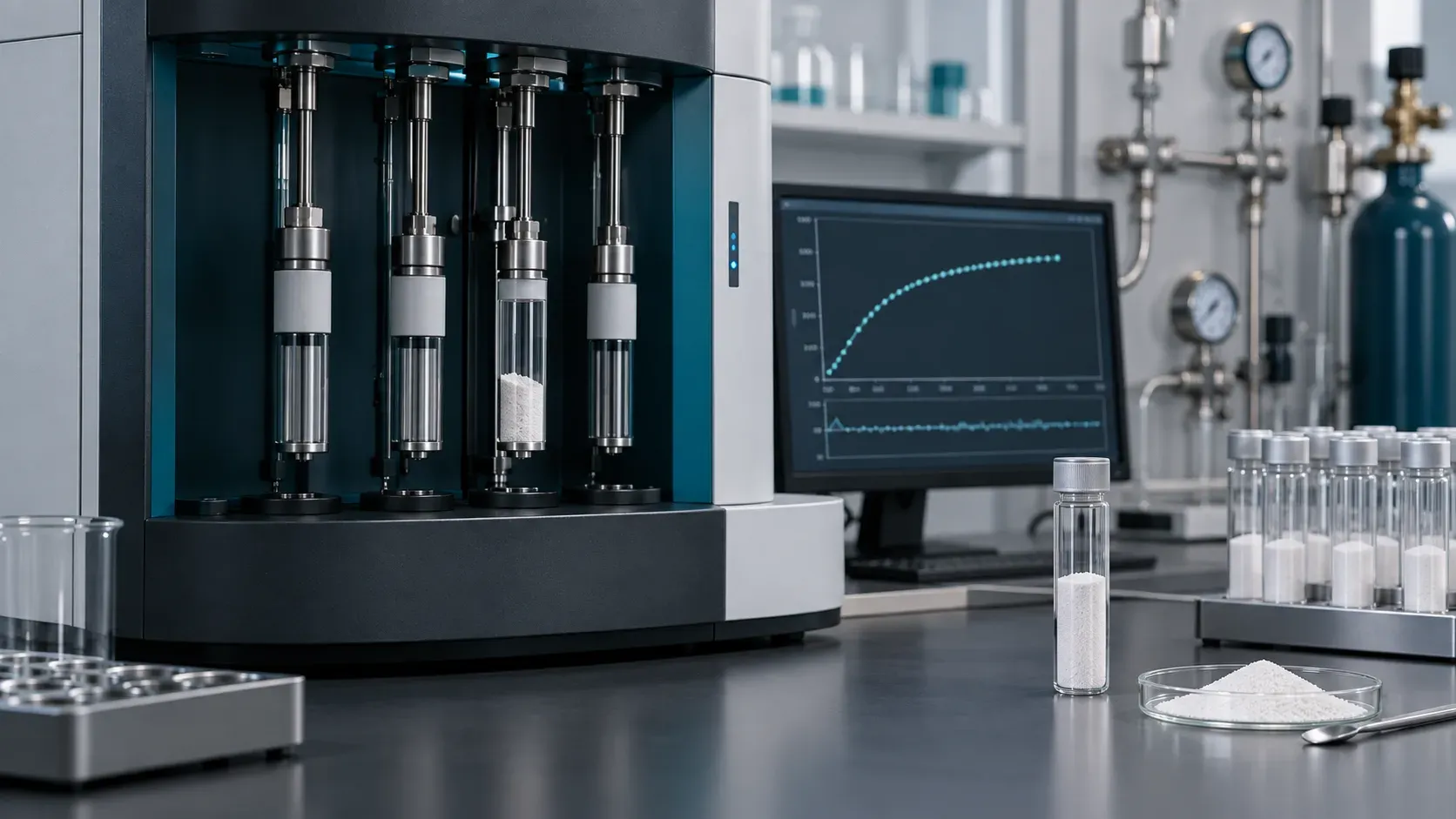
BET surface area can help explain why two silica powders with similar chemistry and nominal size behave differently. It is not a universal quality score. The result depends on sample preparation, gas adsorption conditions, accessible surface and the material's structure, so a useful comparison starts with a defined application question and a matched test method.
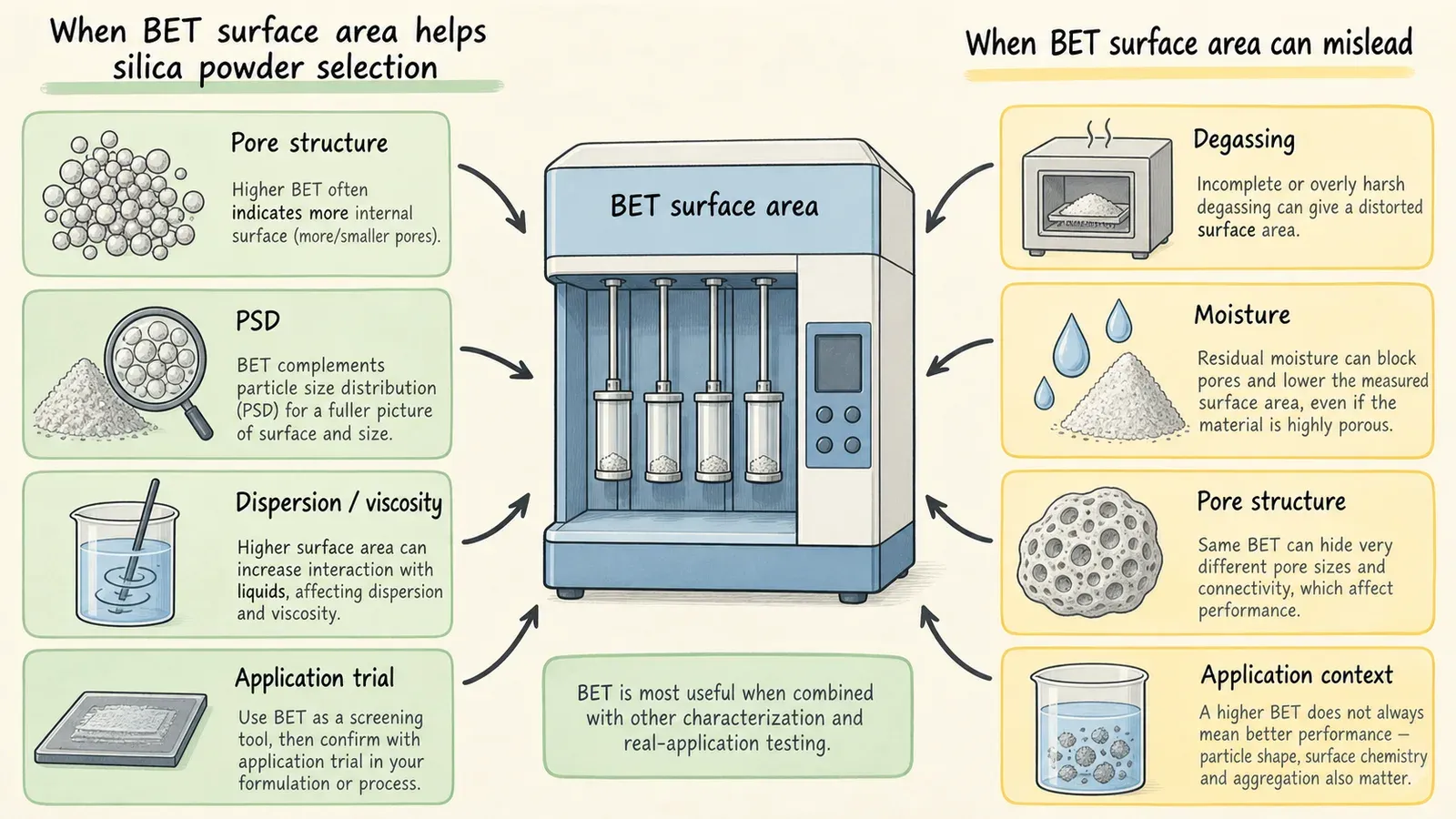
What BET is actually measuring
A BET result estimates the surface area accessible to the adsorbate under the selected measurement conditions. For a nonporous or lightly porous mineral powder, the number is often influenced by particle size and surface roughness. For a treated or porous material, pore accessibility and pretreatment can become equally important.
Use the result to compare samples measured by the same laboratory method. Do not compare a supplier's BET value to an internal value when degassing temperature, time, gas mixture or calculation range differs. Method alignment matters before the number is used in a specification.
Control degassing and moisture
Water and other adsorbed species occupy surface sites and can change the measured adsorption curve. Record sample mass, drying or degassing temperature, hold time and whether the material received a surface treatment. A high-temperature pretreatment can also change a sensitive coating or treated powder, so it must be technically justified.
Run a reference material or retained control when the method is introduced. If duplicate results drift, investigate sample storage and conditioning before changing the acceptance range. A repeatable method is more valuable than a precise-looking number that is not comparable.
Separate size, surface and treatment effects
A finer powder often presents more external surface per unit mass, but BET should not be used as a disguised PSD result. Request the particle-size method and the BET method as separate fields. If the powder is hydrophobic or silane-treated, record the treatment route and wetting behavior because the accessible surface in the formulation may differ from the dry test result.
For a resin, coating or elastomer trial, hold loading and mixing energy constant and observe wetting time, viscosity build, dispersion, air release and cured appearance. For a dry mix, track water demand, flow and packing. The application result decides whether a BET difference matters.
Write a defensible purchasing line
A robust requirement names the test method, sample conditioning, reporting unit, result type and acceptance logic. It also states whether the value is a typical reference, a release limit or a customer-side comparison target. Avoid copying a single historical result into a universal promise.
When a candidate falls outside the expected range, do not reject it from BET alone. Check PSD, moisture, phase, chemistry and the trial response, then document the reason for acceptance or rejection.
Decision matrix
| BET result | Possible interpretation | Do not skip |
|---|---|---|
| Higher than control | Finer or more accessible surface | Check PSD and dispersion |
| Lower than control | Coarser or less accessible surface | Check packing and wetting |
| Wide duplicate spread | Conditioning or method instability | Repeat degassing and reference check |
| Similar BET, different performance | Surface chemistry or process dominates | Review treatment and full trial |
Practical checklist
- Define the application question before requesting BET.
- Match degassing, gas and calculation conditions.
- Keep BET separate from PSD and chemistry fields.
- Record whether values are typical, limits or comparison data.
- Confirm the decision in a formulation or process trial.
Related technical reading
Use these current pages to connect the test plan to the next purchasing or formulation decision:
These links provide context only. Confirm the current grade, lot documents and customer-side trial conditions before approval.
Discuss a silica material trial
Send the application, material identity, target method, acceptance fields, expected quantity and required documents. Changtong can help structure a sample and evidence review without treating a single laboratory value as a performance guarantee.