Cristobalite–Graphite Silicone PTC Composites: Qualifying the Switching Window
Review cristobalite–graphite silicone PTC research through composition, percolation, heating/cooling response and repeatability, without assuming a product switch rating.
Industrial application guide · Technical review ·
Cristobalite–Graphite Silicone PTC Composites: Qualifying the Switching Window
Cristobalite can be a research variable in a conductive graphite–silicone composite, rather than simply a white filler in an insulating compound. The buyer’s question is whether a phase-linked resistance change is repeatable in a defined composition and temperature history.
What the published evidence establishes
Harada and colleagues prepared graphite/cristobalite-form SiO₂/silicone-rubber PTC composites. Their abstract associates a reversible PTC effect with the SiO₂ transition near 270°C and reports repeatability on repeated runs. The stronger effect occurred at an intermediate composition on the conductor–insulator percolation curve. A separate AlPO₄ system transitioned near 230°C; AlPO₄ is not silica and its temperature must not be assigned to a cristobalite powder grade. [1]
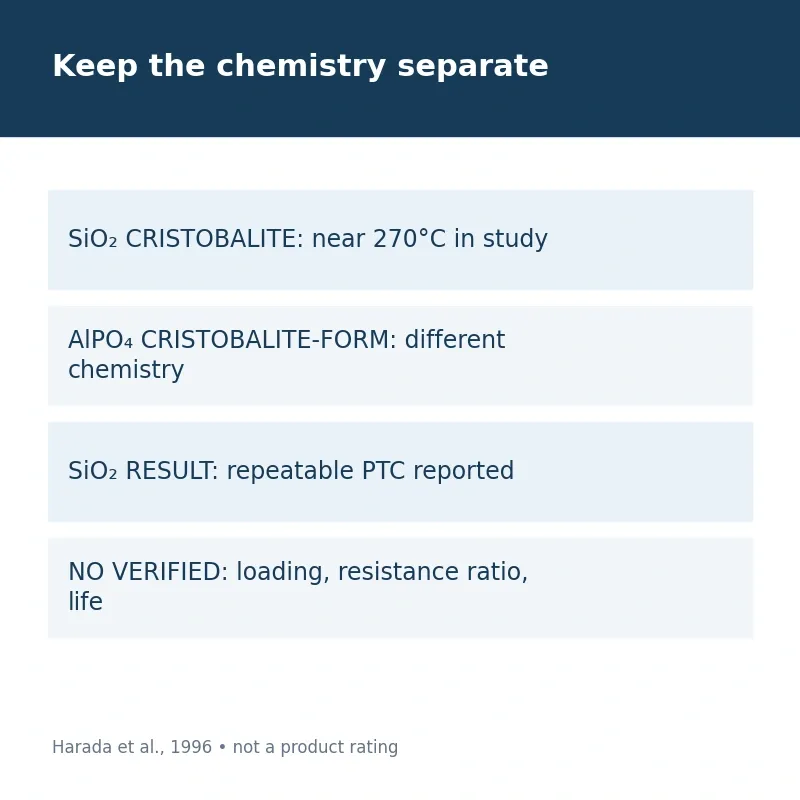
Specify a research specimen, not a certified heater
The published result is a materials observation. It does not establish a safe operating temperature for a silicone product or prove a finished device self-regulates under voltage. Define specimen dimensions, electrode arrangement, measurement mode and allowed thermal exposure before formulation work. The polymer and application must independently tolerate the qualification conditions.
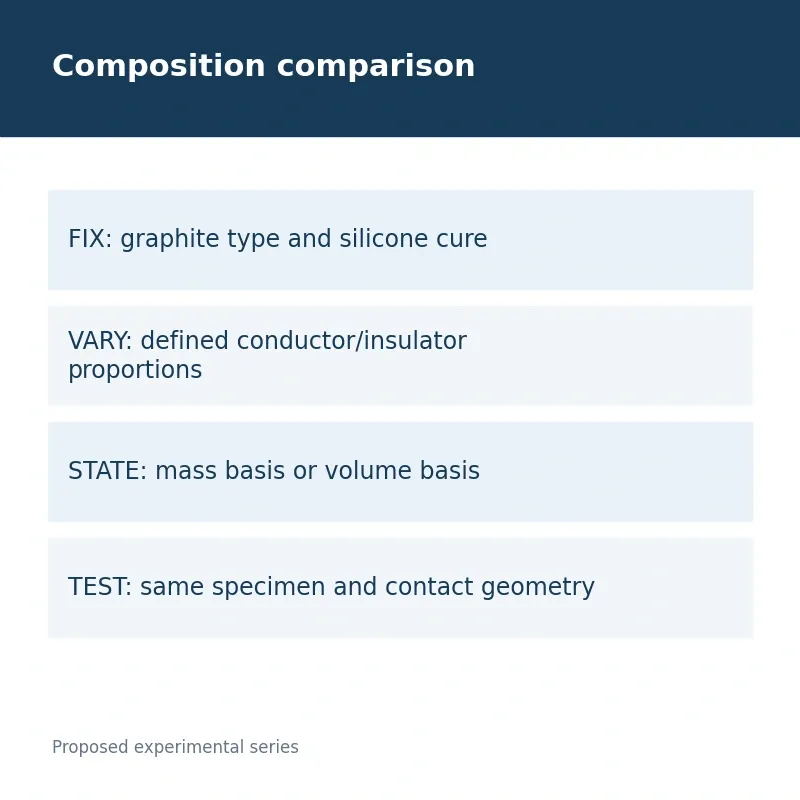
Search composition space around the electrical transition
A conductive network can respond strongly to modest formulation changes. Build a small, documented composition series rather than selecting a single graphite percentage from an unrelated source. State whether proportions are by mass or volume and identify all additives. Keep graphite type, silicone cure and mixing history fixed when comparing cristobalite candidates. Record room-temperature behavior before interpreting the elevated-temperature response.
Measure heating and cooling as separate records
For each composition, document resistance or resistivity with units, specimen geometry, contact method and temperature measurement location. Compare heating and cooling under the same defined program and repeat the program according to the application’s evaluation plan. Track baseline drift, the switching region and recovery. Repeatability must include variation between specimens, not only repeated readings of one sample.
| Comparison | Record to retain | Decision use |
|---|---|---|
| Composition series | Graphite, SiO₂ cristobalite, silicone and cure | Map response with consistent proportion units |
| Temperature program | Heating/cooling history and actual specimen temperature | Identify switching region and recovery |
| Repeatability | Multiple specimens, cycle count and baseline drift | Separate research effect from qualification |
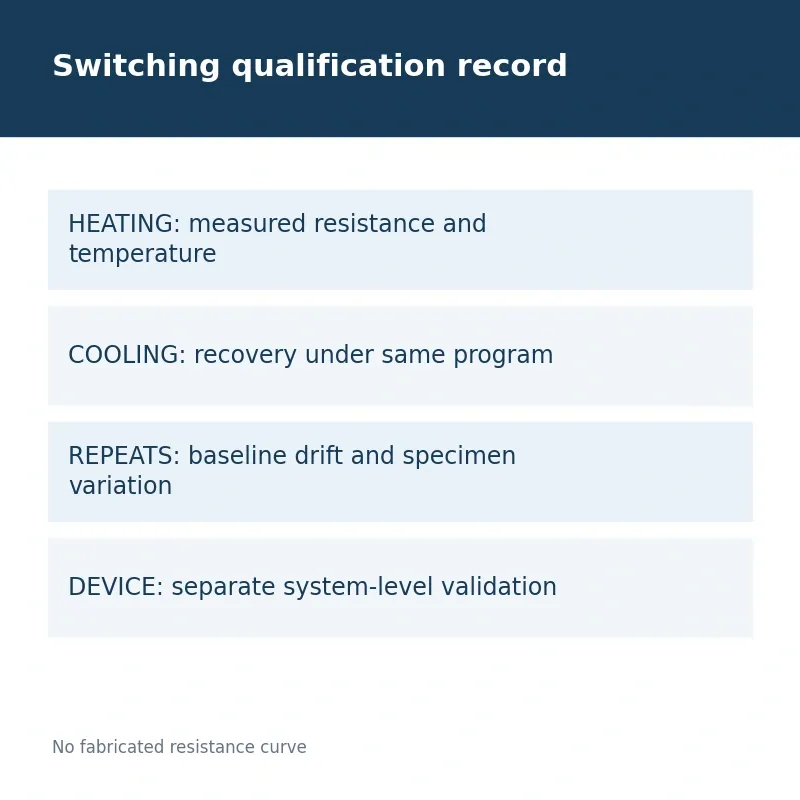
Separate contact effects from bulk response
Changes at electrodes can distort a resistance-versus-temperature result. Preserve contact geometry and investigate specimens that show abrupt or irreproducible changes. Pair electrical results with phase information and an appropriate dimensional or thermal observation where feasible. A transition-temperature reference should guide investigation, not replace measurement of the actual compound. Keep promising results as research findings until component and system validation is complete.
Evidence boundary: Published research is an industry reference, not Changtong test data or a product guarantee. Foundation reference. Publisher abstract reviewed. Filler fractions, absolute resistivity, PTC magnitude and endurance-cycle counts have not been verified here.
Frequently asked questions
Is 270°C a guaranteed switch point?
No. It is an approximate value reported for the study’s SiO₂ system, not a universal grade specification or service-temperature rating.
Can the AlPO₄ result be used for a silica product?
No. Cristobalite-form AlPO₄ has different chemistry. Keep its evidence separate from SiO₂ cristobalite.
For candidate material discussions, review Calcined cristobalite powder for silicone-rubber trials. Product availability and application fit require current documentation and customer qualification.
Request an application-specific trial discussion
For exploratory PTC compound work, provide graphite type, silicone system, proportion convention, specimen design and the qualified electrical/thermal test plan. Request phase and lot data for a cristobalite screening sample.
Discuss a documented material trialReference and review scope
[1] Harada, T.; Ikeda, N.; Ota, T.; Hikichi, Y.; Unuma, H.; Takahashi, M.; Suzuki, H. Preparation of Graphite/Critstobalite/Silicone Rubber PTC Composites [publisher title spelling]. Journal of the Ceramic Society of Japan 104(1216), 1133–1136 (1 December 1996). DOI: 10.2109/jcersj.104.1133. Peer-reviewed journal article. Foundation reference. Publisher abstract reviewed. Filler fractions, absolute resistivity, PTC magnitude and endurance-cycle counts have not been verified here. Source checked 9 October 2026. All numeric figures are reference values, with their original material context.
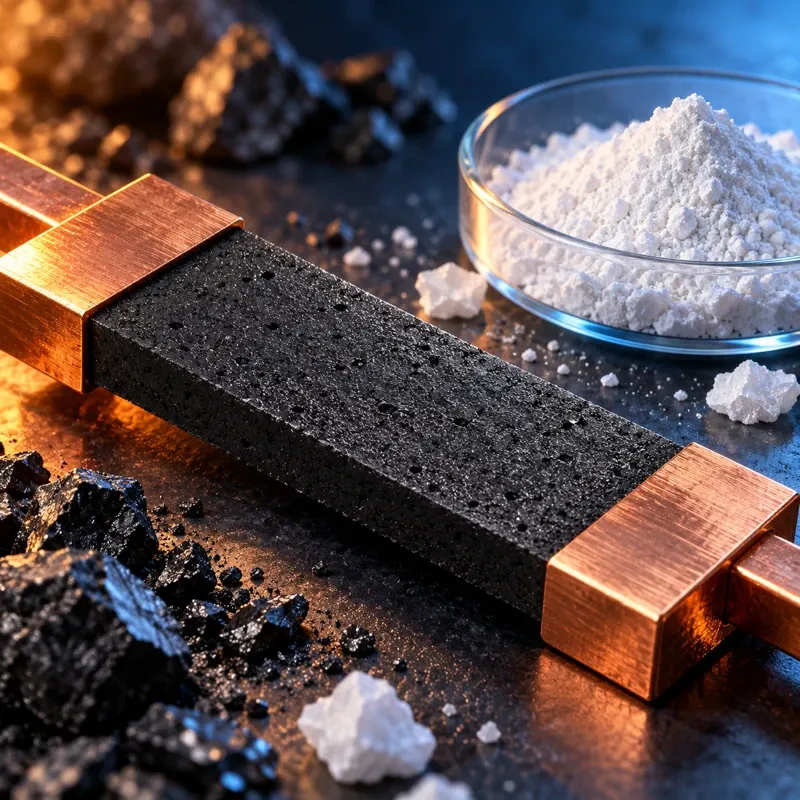
Cover: AI-generated application illustration, not a photograph of Changtong production or an experimental result. Body figures are original evidence summaries and proposed comparison plans.