Cristobalite vs Precipitated Silica in Silicone Rubber
Can calcined cristobalite partially replace precipitated silica in silicone rubber? Review M4000 batch data, separate PSD evidence, application boundaries and a practical qualification plan.

Buyer question: Can calcined cristobalite replace precipitated silica in silicone rubber?
Short answer: it can be evaluated as a controlled partial component of the filler system, but it should not be treated as a universal one-for-one replacement for reinforcing precipitated or fumed silica. Changtong M4000 offers documented chemistry, particle-size and colour-control data that make it a practical candidate for compound trials. The acceptable replacement level still depends on the silicone gum, reinforcing-filler network, surface treatment, cure package, mixing sequence and required mechanical properties.
First, distinguish the filler roles
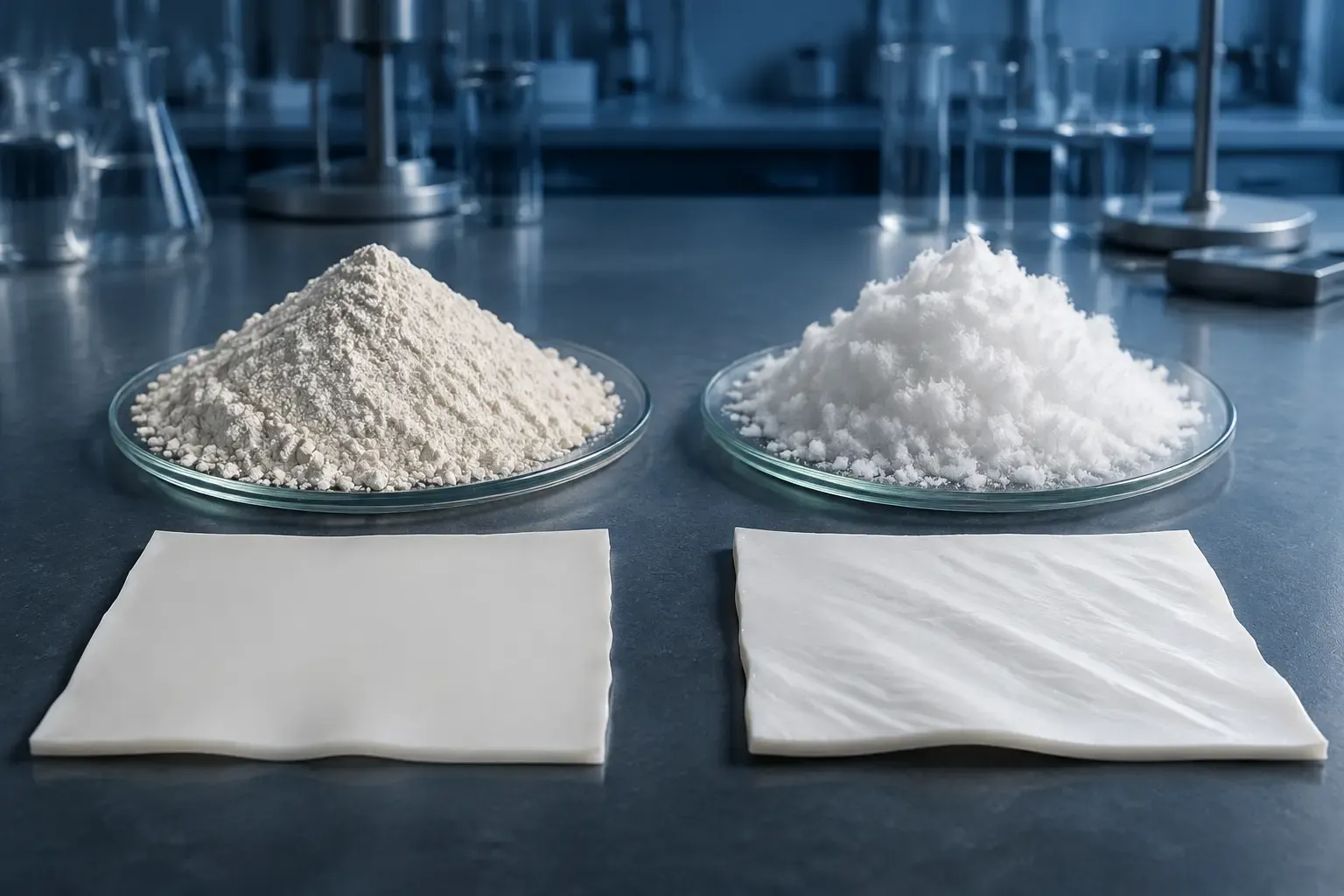
“Silica” is not a single interchangeable ingredient. Calcined cristobalite is a crystalline SiO2 mineral phase produced by high-temperature treatment and grinding. Precipitated silica and fumed silica are synthetic amorphous silicas with different structures, surface areas and reinforcing behaviour. Their names, manufacturing routes and functions should remain separate during sourcing and formulation review.
| Material | Identity | Typical formulation role | Replacement boundary |
|---|---|---|---|
| Calcined cristobalite powder | Crystalline silica polymorph; ground mineral filler | Mineral loading, colour/appearance control, processing and compound-property adjustment | Evaluate as part of a hybrid filler system; do not assume reinforcing equivalence |
| Precipitated silica | Synthetic amorphous silica | Common reinforcing and rheology-building filler | Performance depends on surface area, structure, surface chemistry and dispersion |
| Fumed silica | Flame-produced amorphous silica | High-surface-area reinforcement and rheology control | Not equivalent to ground cristobalite by equal weight |
What the M4000 batch report actually confirms
The following values come from Changtong's M4000 inspection report dated 20 August 2026, sample 260820-1. The report cites SJ/T 10675-2002. They describe the tested sample only; buyers should request the current lot COA before placing contractual limits.
| Reported item | M4000 result | Why it matters in screening |
|---|---|---|
| Median particle size, d(0.5) | 6.15 µm | Supports a defined starting point for dispersion, calendering and surface-finish trials |
| SiO2 | 99.63% | Documents the high-silica composition of the tested sample |
| Fe2O3 | 0.009% | Low reported iron is relevant when colour cleanliness matters |
| Al2O3 | 0.21% | Provides an additional chemistry-control point |
| Moisture | 0.1% | Moisture control can be important for storage and compound consistency |
| Specific gravity | 2.35 g/cm3 | Useful when converting phr, weight and compound-volume calculations |
| pH | 7.8 | A screening input for cure-package compatibility; validate in the customer's system |
| Whiteness | 94% | Supports white, light-grey and pigmented compound trials |
| Activation rate | 95% | Report value to be reviewed together with the current test method and surface-treatment declaration |
PSD evidence: useful, but not the same batch
A separate particle-size distribution record dated 12 November 2024 provides the distribution below. Its D50 is 7.65 µm, while the 2026 sample report gives d(0.5) of 6.15 µm. These results must not be blended or presented as one batch. Method, dispersion conditions and lot identity should be aligned before comparing values contractually.
| PSD percentile | 12 Nov 2024 result | Evidence scope |
|---|---|---|
| D10 | 1.44 µm | Separate historical PSD record; use as grade-screening evidence, not the COA for sample 260820-1 |
| D50 | 7.65 µm | |
| D90 | 20.54 µm | |
| D95 | 24.89 µm | |
| D97 | 27.74 µm |
The supplied product brief also lists a typical median range of 5–8 µm and oil absorption of 25.2 g/100 g. Oil absorption is a brief-level value without a supplied method or lot reference, so it should be confirmed against the current TDS/COA and agreed test method before purchase specifications are fixed.
What effects should a silicone-rubber customer evaluate?
Changtong's supplied application brief identifies dispersion, calendering or extrusion behaviour, colour development, cure response, compound tack and mechanical-property retention as the practical reasons to screen M4000. These are formulation observations, not universal guarantees. The useful question is not “Does cristobalite work?” but “At what loading and mixing sequence does this grade meet our finished-part targets?”
| Customer objective | Why M4000 may be considered | What must be measured |
|---|---|---|
| White or coloured compounds | 94% whiteness and 0.009% Fe2O3 in sample 260820-1 provide concrete colour-control inputs | L*a*b* colour, visual cleanliness, post-cure colour and ageing shift |
| Stable mixing and shaping | Micronised PSD and controlled moisture support a defined dispersion trial | Mix time, roll release, extrusion pressure, surface finish and agglomerates |
| Adjust filler-system economics | A mineral filler can be screened as a partial component rather than relying on one filler type alone | Cost per acceptable finished part—not cost per kilogram alone |
| Maintain final performance | Supplier brief reports a partial-substitution application observation | Tensile, tear, elongation, hardness, compression set, cure and ageing |
Can it replace 50% of the precipitated silica?
The supplied application brief reports a formulation trial in which 50% of the white carbon black portion was replaced and no obvious change was observed in the listed mechanical properties. In Chinese rubber-industry usage, “white carbon black” commonly refers to reinforcing synthetic silica, not carbon black and not ground cristobalite.
Published silicone-rubber research reinforces this boundary. Filler dispersion and cross-linked network structure materially affect mechanical behaviour, and changing the filling method can change dispersion and final results. These studies concern their own silica systems; they support the need for controlled trials but do not validate M4000 performance by themselves.
A controlled qualification plan
Record the silicone gum, reinforcing silica, additives, cure package, mixer, temperature, time and sequence.
Start below the brief-reference level, then increase only if processing and cured properties remain inside limits.
Compare dispersion, roll release, compound viscosity, scorch/cure behaviour, extrusion or calendering and surface finish.
Test tensile, tear, elongation, hardness, compression set, heat ageing and any application-specific electrical or sealing requirement.
Where the M4000 profile may be useful
The supplied application material identifies silicone-rubber products such as rollers, hoses and wire or cable components as possible evaluation areas. Suitability depends on the duty: a roller may prioritise finish and abrasion; a hose may prioritise tear, flexibility and compression set; an electrical part may require dielectric and tracking tests. For broader material-selection context, see Changtong's rubber and resin compound compatibility guide. Buyers comparing other cristobalite uses can also review the high-whiteness cristobalite grade overview.
Because cristobalite is crystalline silica, powder handling must follow the current SDS, local regulations and the customer's exposure-control programme. Use closed transfer or local exhaust where appropriate, control airborne dust, and select respiratory protection through a competent safety assessment. NIOSH and OSHA both treat respirable cristobalite as respirable crystalline silica; this safety distinction is different from amorphous precipitated or fumed silica.
Frequently asked questions
Is calcined cristobalite the same as precipitated silica?
No. Cristobalite is a crystalline SiO2 polymorph and M4000 is a ground mineral filler. Precipitated silica is synthetic amorphous silica. They can occupy different roles in a compound and should not be specified as identical materials.
Does M4000 guarantee a 50% replacement?
No. The supplied brief provides a 50% partial-substitution trial observation, but it lacks the full test protocol needed for a transferable guarantee. Treat it as a starting hypothesis and validate a staged ratio in your own formulation.
Which M4000 value is the correct D50?
The 20 August 2026 sample report records d(0.5) at 6.15 µm. A separate 12 November 2024 PSD record gives D50 at 7.65 µm. Both can be reported with their evidence dates, but they must not be represented as the same batch.
What should be included in a sample qualification?
At minimum, compare processing, dispersion, cure behaviour, tensile strength, tear strength, elongation, hardness, compression set, colour and ageing against the unchanged baseline. Add electrical, sealing or abrasion tests when the finished part requires them.
Evidence and reference boundary
This guide uses Changtong's M4000 inspection report (20 August 2026, sample 260820-1), a separate PSD record (12 November 2024) and the supplied silicone-rubber application brief. Public studies are used only to explain why dispersion, filler network and mixing method require customer-specific validation; their results are not Changtong batch data.
- Jiang and Yong, Modulation of Mechanical Properties of Silica-Filled Silicone Rubber by Cross-Linked Network Structure (2024)
- Li et al., The Effects of Filling Method on Silicone Rubber Composites Filled with SiO2 and TiO2 (published online 2024; journal issue 2025)
- NIOSH: Silica and Worker Health
Request M4000 Data and a Formulation Sample
Send us your silicone type, current reinforcing-silica grade, filler loading, processing route, cure system, colour target and required mechanical properties. We can align the current M4000 documentation and sample scope with your controlled trial.