Fused Silica Ceramic Cores: Compare Leachability After Casting Heat Exposure
Compare fused silica ceramic-core strength and leachability after representative casting heat exposure, including the zircon-content tradeoff and removal endpoint.
Industrial application guide · Technical review ·
Fused Silica Ceramic Cores: Compare Leachability After Casting Heat Exposure
A ceramic core must survive handling and casting, then leave the internal passage cleanly. Qualification of a fused-silica-based core should therefore compare strength and removability after the representative casting heat history, rather than only in the as-sintered condition.
What the published evidence establishes
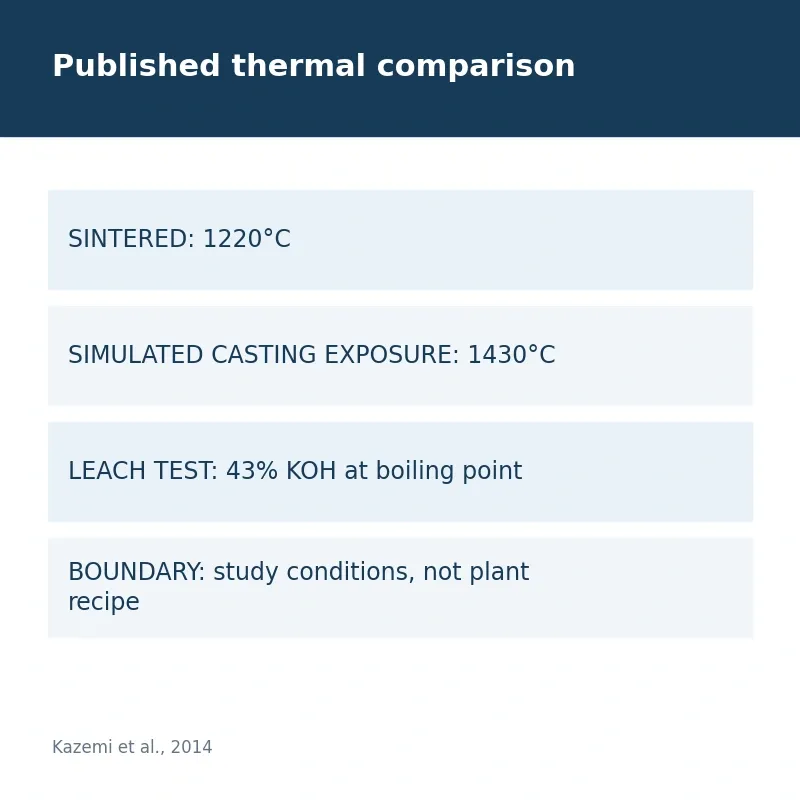
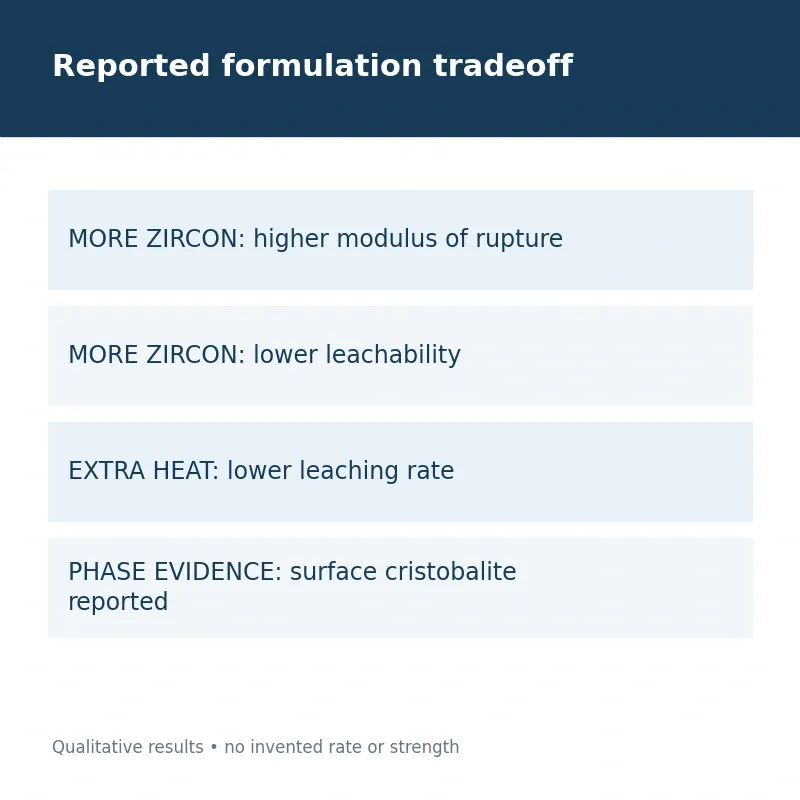
Kazemi and colleagues investigated injection-molded silica-based ceramic cores containing fused silica and zircon. Samples sintered at 1220°C were subsequently exposed to 1430°C to simulate casting. Three-point bending, XRD and SEM were used; leaching was assessed in 43% KOH at its boiling point. More zircon increased modulus of rupture while reducing leachability. Across the investigated zircon contents, the additional heat treatment reduced leaching rate, associated with cristobalite crystallization on fused-silica particle surfaces. [1]
Use the right material and removal question
This is a core-removal problem inside a casting, distinct from breaking an external ceramic shell. Define core geometry, passage access, alloy and casting heat exposure before requesting powder. A favorable result on a small open specimen may not represent a long or restricted passage. Compare retained core material from the same manufacturing batch wherever possible.
Build an as-sintered versus heat-exposed comparison
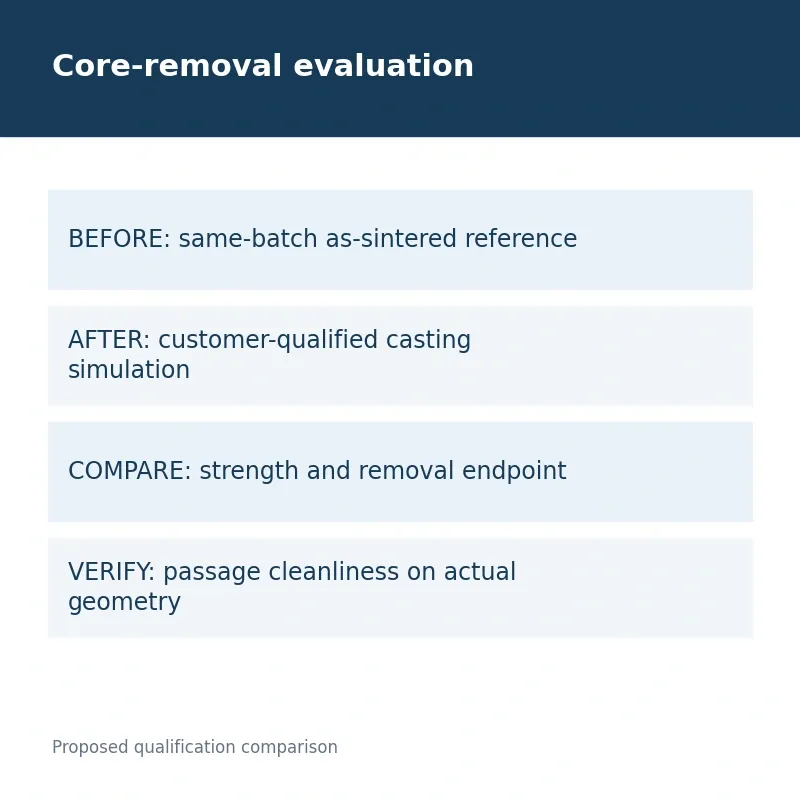
Keep core formulation, injection process, debinding and sintering constant while evaluating the additional heat history. Use the customer’s qualified simulation rather than copying the study’s temperatures into an unrelated process. Record shrinkage, apparent defects and the mechanical-test geometry. A higher room-temperature bending result is not by itself proof of suitable behavior during pouring.
Define removability with a measurable endpoint
Use the plant’s qualified removal process and state the endpoint: mass loss under a documented test, time to complete removal, or verified passage cleanliness, as appropriate. Record specimen surface area and solution/process history if they affect comparability. The research KOH concentration and boiling condition are reported for traceability, not as operating instructions. Plant chemical removal requires its own qualified equipment and procedure.
| Comparison | Record to retain | Decision use |
|---|---|---|
| Core survival | Geometry, process history and defined strength test | Assess handling and casting requirements |
| Removal after exposure | Same core batch; documented heat simulation | Avoid relying only on as-sintered data |
| Passage acceptance | Removal endpoint and cleanliness verification | Connect coupon results to the casting |
Review zircon content as a tradeoff
When comparing formulations, state zircon fraction and its convention, then examine both mechanical acceptance and the removal endpoint. Pair phase and microstructure observations with the process history to explain a slower-removing core. Do not label every difficult removal result a powder-purity problem. Optimize against a defined casting and passage requirement; the abstract does not supply a universal zircon percentage or a guaranteed removal time.
Evidence boundary: Published research is an industry reference, not Changtong test data or a product guarantee. Foundation reference. Institutional peer-reviewed publication record and abstract reviewed. Absolute MOR, leaching rates and zircon fractions were not verified here.
Frequently asked questions
Is ceramic-core removal the same as shell knockout?
No. Internal passages create different access and removal requirements; shell-knockout evidence cannot replace a core trial.
Is more zircon always better?
No. The cited study reports a strength/removability tradeoff, so selection depends on the actual casting requirement.
For candidate material discussions, review Changtong fused silica range. Product availability and application fit require current documentation and customer qualification.
Request an application-specific trial discussion
Provide the core-forming route, formulation and zircon fraction, casting heat history, passage geometry, strength criteria and qualified removal endpoint. Request fused-silica phase, grading and chemistry records for a matched trial.
Discuss a documented material trialReference and review scope
[1] Kazemi, A.; Faghihi-Sani, M. A.; Nayyeri, M. J.; Mohammadi, M.; Hajfathalian, M. Effect of zircon content on chemical and mechanical behavior of silica-based ceramic cores. Ceramics International 40(1 Part A), 1093–1098 (January 2014). DOI: 10.1016/j.ceramint.2013.06.108. Peer-reviewed journal article. Foundation reference. Institutional peer-reviewed publication record and abstract reviewed. Absolute MOR, leaching rates and zircon fractions were not verified here. Source checked 9 October 2026. All numeric figures are reference values, with their original material context.
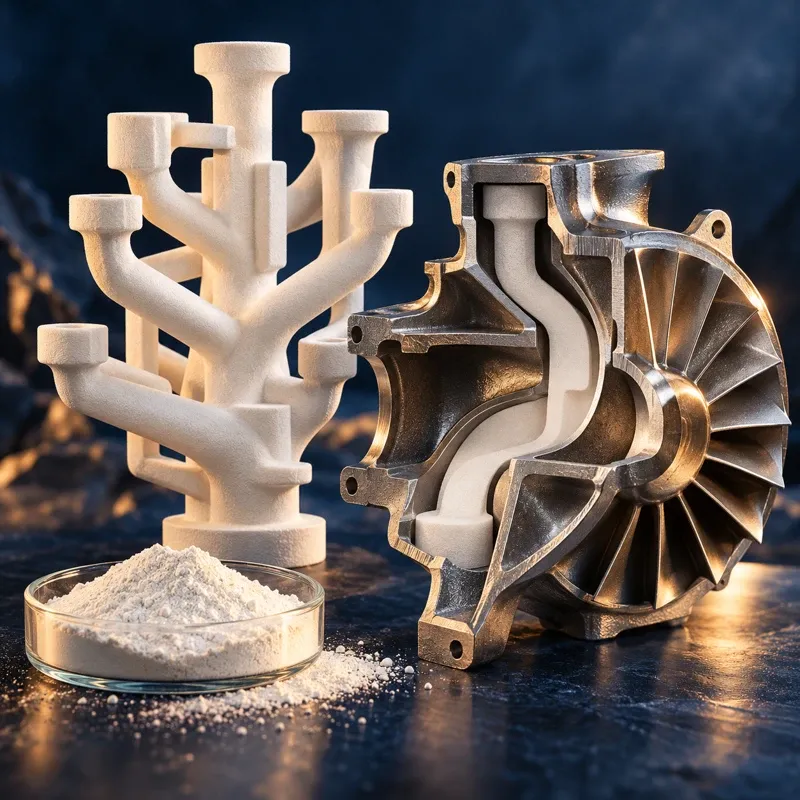
Cover: AI-generated application illustration, not a photograph of Changtong production or an experimental result. Body figures are original evidence summaries and proposed comparison plans.