Pilot-Scale Quartz Filler Trials: A Decision Matrix from Lab to Production
Move a quartz filler comparison from beaker to pilot mixer with a decision matrix that separates material effects from scale-up effects.

This technical guide is a screening and trial framework. It does not establish a universal grade limit or guarantee finished-product performance; approval remains tied to the buyer’s method, formulation and applicable requirements.
Start with the decision, not the number
A laboratory result is a starting point, not a production approval. When a quartz filler moves from a small cup to a pilot mixer, fill order, shear, heat removal, residence time and discharge can change the result. A simple decision matrix keeps those variables visible and shows what must be repeated before a grade is released for routine production.
Define the scale-up question
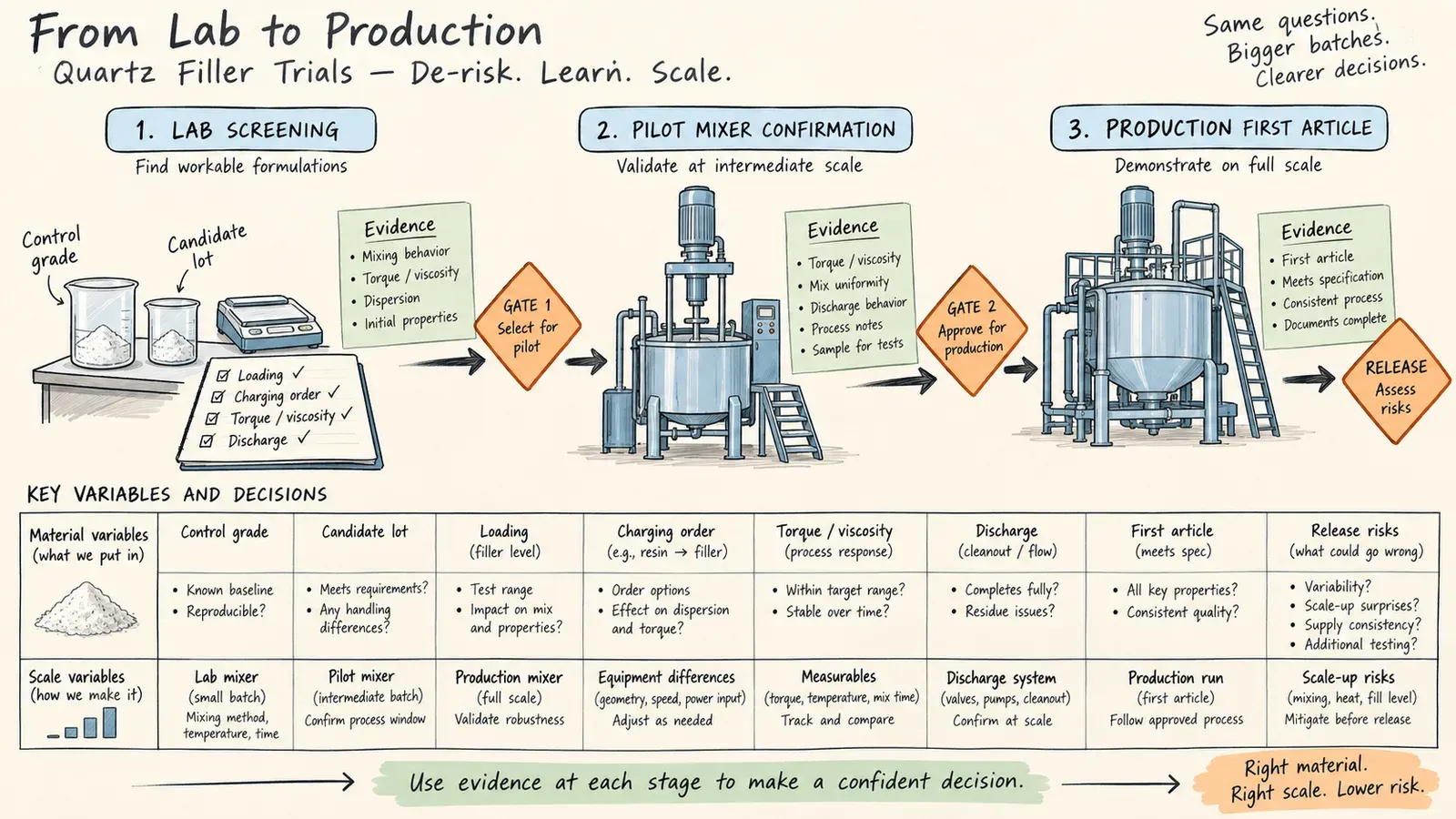
State what must remain constant: filler identity, target loading, binder ratio, mixing sequence, temperature window, cure or firing schedule and acceptance tests. Then state what is expected to change at pilot scale, such as mixer geometry, batch mass, energy per kilogram or residence time.
Do not ask a pilot trial to answer every question at once. Decide whether the first run is checking dispersion, throughput, appearance, mechanical performance or all of these in a staged sequence.
Build the matrix
Use the current approved grade as the control and compare one candidate at a time. Record material lot, PSD method, moisture, density, loading and charging order. Keep a separate column for equipment settings and operator observations so a scale effect is not mislabelled as a material effect.
A useful matrix has three layers: laboratory screening, pilot confirmation and production first-article. The acceptance rule for each layer should be written before the batch is mixed. If the result is inconclusive, record the next check instead of forcing a pass/fail conclusion.
Watch the transfer variables
At pilot scale, monitor powder addition time, mixer torque or power trend, wetting sequence, temperature, dust-control response, discharge condition and hold-up. For a resin or polymer compound, include viscosity over time and air release. For a dry mix, include flow, segregation and bag or feeder behavior.
Use the same sample and test preparation for both scales whenever possible. If a different instrument or panel size is required, record the difference and avoid comparing raw values without context.
Make the release decision traceable
A release recommendation should state the tested grade and lot, formulation version, equipment, process window, results, deviations and remaining risks. It should also define what incoming evidence must be checked for later lots. A successful pilot does not remove the need for routine lot control.
If the candidate fails, classify the failure. The cause may be PSD, moisture, surface treatment, equipment energy, charging order or the binder system. That classification determines whether to retest the material or redesign the process.
Decision matrix
| Stage | Main question | Evidence |
|---|---|---|
| Lab screen | Does the candidate fit the formulation window? | PSD, moisture, mixing and bench result |
| Pilot | Does the process transfer at useful scale? | Power, temperature, flow and trial result |
| First article | Is the production route repeatable? | Lot record, settings and finished inspection |
| Routine supply | Can later lots be released consistently? | COA, sampling and change control |
Practical checklist
- Write the scale-up question and control variables.
- Use the approved grade as a matched control.
- Record equipment and material variables separately.
- Set acceptance rules before each trial stage.
- Carry the tested lot, process window and residual risks into release.
Related technical reading
Use these current pages to connect the test plan to the next purchasing or formulation decision:
These links provide context only. Confirm the current grade, lot documents and customer-side trial conditions before approval.
Discuss a silica material trial
Send the application, material identity, target method, acceptance fields, expected quantity and required documents. Changtong can help structure a sample and evidence review without treating a single laboratory value as a performance guarantee.