
How to Specify a Quartz Boat for Semiconductor Thermal Processing
Learn what to include in a quartz boat RFQ: wafer details, slot geometry, clearances, thermal conditions, surface finish and first-article inspection.

Specify a quartz boat from the wafer, furnace and handling system outward.
A useful quartz-boat RFQ starts with more than wafer diameter. It ties slot geometry and loading clearances to the furnace interface, thermal cycle, surface criteria and acceptance evidence, giving a supplier enough information to review fit and manufacturability.
Last updated: · Scope: quartz boat specification, RFQ preparation and first-article review
Why Does a Quartz Boat Need a Process-Specific Specification?
A quartz boat is a process fixture as well as a shaped quartz component. Its dimensions determine whether wafers can be loaded, separated, supported and removed without unwanted contact. Its interface with a tube, paddle, rack or automation system determines whether the part can be used repeatedly in the intended equipment. The process atmosphere and thermal cycle add another layer of review because the boat must remain fit for service under the customer’s actual conditions.
Changtong’s published quartzware offering includes plates, boats and trays for laboratory thermal processing, optical assemblies and semiconductor-related equipment. The product page identifies dimensions, slot or cavity geometry, surface finish, tolerances and service conditions as inputs for material and manufacturing review. Those are inquiry-level capabilities, not a promise that every geometry, tolerance or process condition is automatically approved.
The specification should therefore describe the complete use case. “Quartz boat for wafers” is a starting description; it is not yet a reproducible manufacturing brief.
What Should a Quartz Boat RFQ Include?
Send the supplier a controlled drawing or a structured specification sheet. If a drawing is not ready, the fields below provide a practical minimum. Use the quartz plates and boats product page as the application starting point, then add the equipment and process details.
| RFQ field | What to state | Why it matters |
|---|---|---|
| Wafer or workpiece | Diameter, thickness range, notch or flat orientation, quantity per load and edge sensitivity | Defines the support geometry and the usable working envelope |
| Boat geometry | Overall envelope, slot count, slot pitch, slot width, depth, end features and datum scheme | Prevents a nominal wafer size from hiding fit and handling risks |
| Equipment interface | Tube or chamber size, paddle/rack interface, loading direction and automation clearances | Confirms that the boat can enter, locate and exit the intended tool |
| Service conditions | Process temperature range, ramp or cycle description, atmosphere, pressure and chemical exposure | Sets the material and design review boundary |
| Acceptance evidence | Dimensional report, visual inspection, surface criteria, packaging and sample approval route | Turns a custom part into a traceable purchasing decision |
How Should Slot Geometry and Clearances Be Defined?
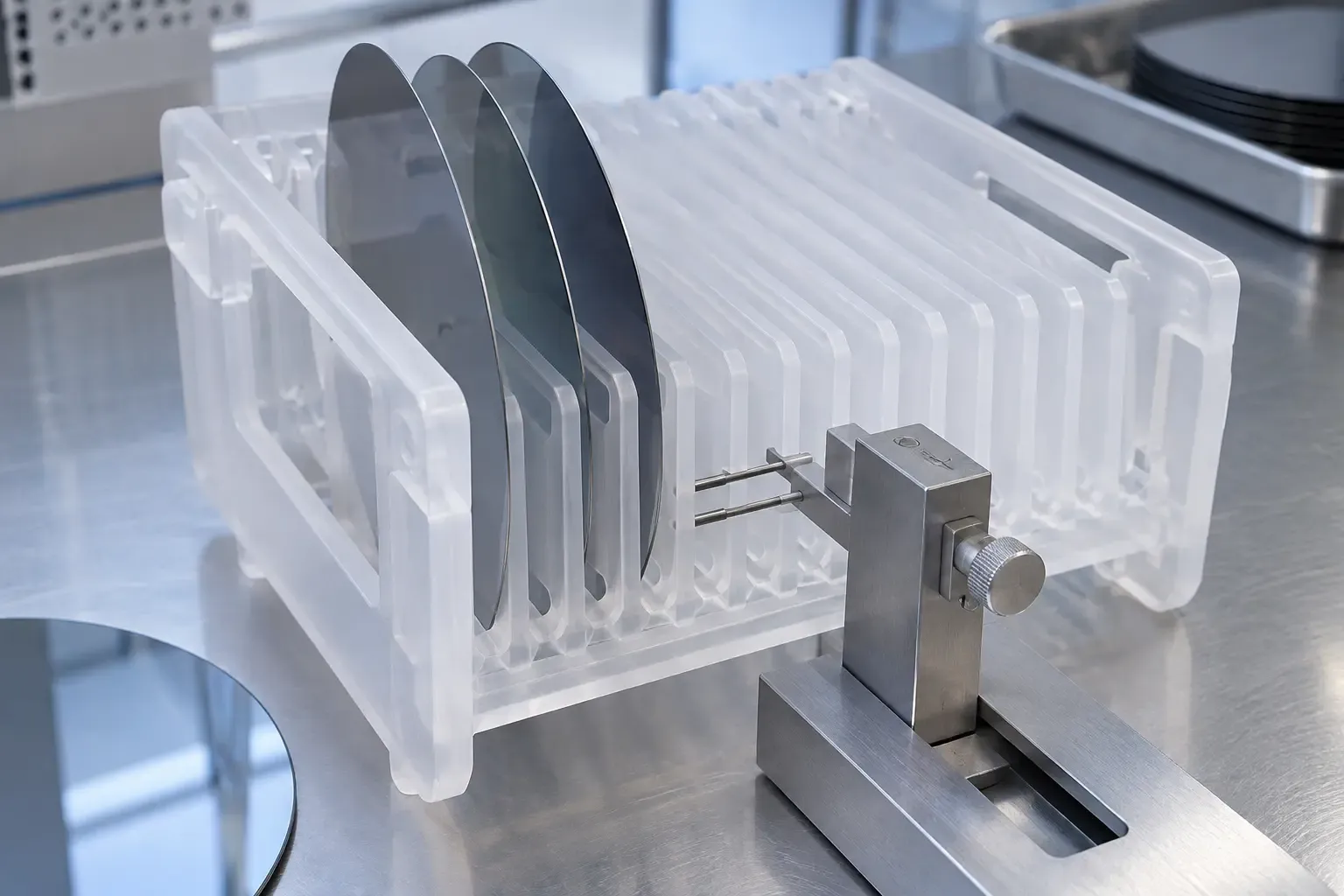
Slot geometry is where many incomplete inquiries become expensive. State the slot pitch, slot width, support depth, entry radius or chamfer, end clearance and the datum used for measurement. If wafers have a notch, flat or orientation requirement, show how the carrier preserves that orientation. If the boat is loaded by hand, robot or paddle, include the approach direction and the space needed for the tool to engage without scraping adjacent slots.
Do not infer the slot pitch from wafer diameter alone. The pitch is also related to the desired load count, process uniformity, cleaning access, wafer thickness tolerance and the handling system. The final value should be confirmed against the customer’s drawing and equipment envelope.
Geometry Review Checklist
| Check | Record | Release question |
|---|---|---|
| Slot position | Datum, pitch, count and end margin | Can every wafer be loaded and removed without edge interference? |
| Contact area | Support location, radius, finish and allowable contact mark | Is the contact repeatable and compatible with the customer’s handling limit? |
| Clearance | Tube, paddle, rack, robot and adjacent-wafer clearance | Does the boat fit through the full loading path, not only the chamber? |
| Orientation | Notch/flat direction and loading reference | Can the process team verify orientation before the run? |
Which Quartz Material and Surface Details Need Review?
“Quartz” should be clarified in the specification. A machined quartz boat is a shaped quartz-glass component; it is not a bag of crystalline silica powder or natural quartz sand. The customer should identify the intended material family, required purity or contamination boundary, surface finish, visible-defect criteria and any cleaning or packaging expectation. Changtong can then review the requested geometry and service conditions against the available manufacturing route.
Surface finish is functional when it affects wafer contact, cleanability, particle generation or visual inspection. Describe whether the requirement applies to all surfaces or only the slots, support areas and process-facing surfaces. If the customer has a sample or approved drawing, use it as the visual reference rather than relying on an unqualified word such as “smooth.”

How Do Thermal and Chemical Conditions Affect the Design Review?
Give the supplier the real process envelope rather than a single headline temperature. Include the working range, ramp or dwell pattern, number of cycles, atmosphere, pressure, reactive species, cleaning exposure and whether the boat is supported continuously or at discrete points. A part that fits at room temperature may still need review for distortion risk, contact behavior, handling after a hot cycle or chemical compatibility in the intended process.
These details are used to screen the design and material route; they do not by themselves establish a guaranteed service life. If the process is new, identify which conditions are confirmed and which are still being qualified. That distinction helps the supplier state a useful boundary instead of making an unsupported durability promise.
What Inspection Evidence Should Be Requested?
For a custom quartz boat, the inspection plan should be agreed before production. The report should map measurements to the drawing or specification revision, identify the inspected part or lot and state the method used for visual and dimensional checks. If the boat is a replacement, compare the critical interface features to the approved sample or previous revision.
- Drawing revision, part identity and traceable production reference.
- Overall dimensions, slot pitch, slot count, slot width and critical clearances.
- Visual inspection of chips, cracks, edge condition, contamination and unacceptable marks.
- Surface-finish or contact-area criteria where the process requires them.
- Packaging, protective separation, cleanliness expectation and receiving inspection steps.
Use the quartz tube specification guide for a related furnace-component RFQ perspective, and see the RFQ specification checklist for a general inquiry structure. The tube guide covers shared process-envelope questions; the boat still requires its own wafer slots, support points and handling interfaces.
How Should a First-Article Quartz Boat Be Qualified?
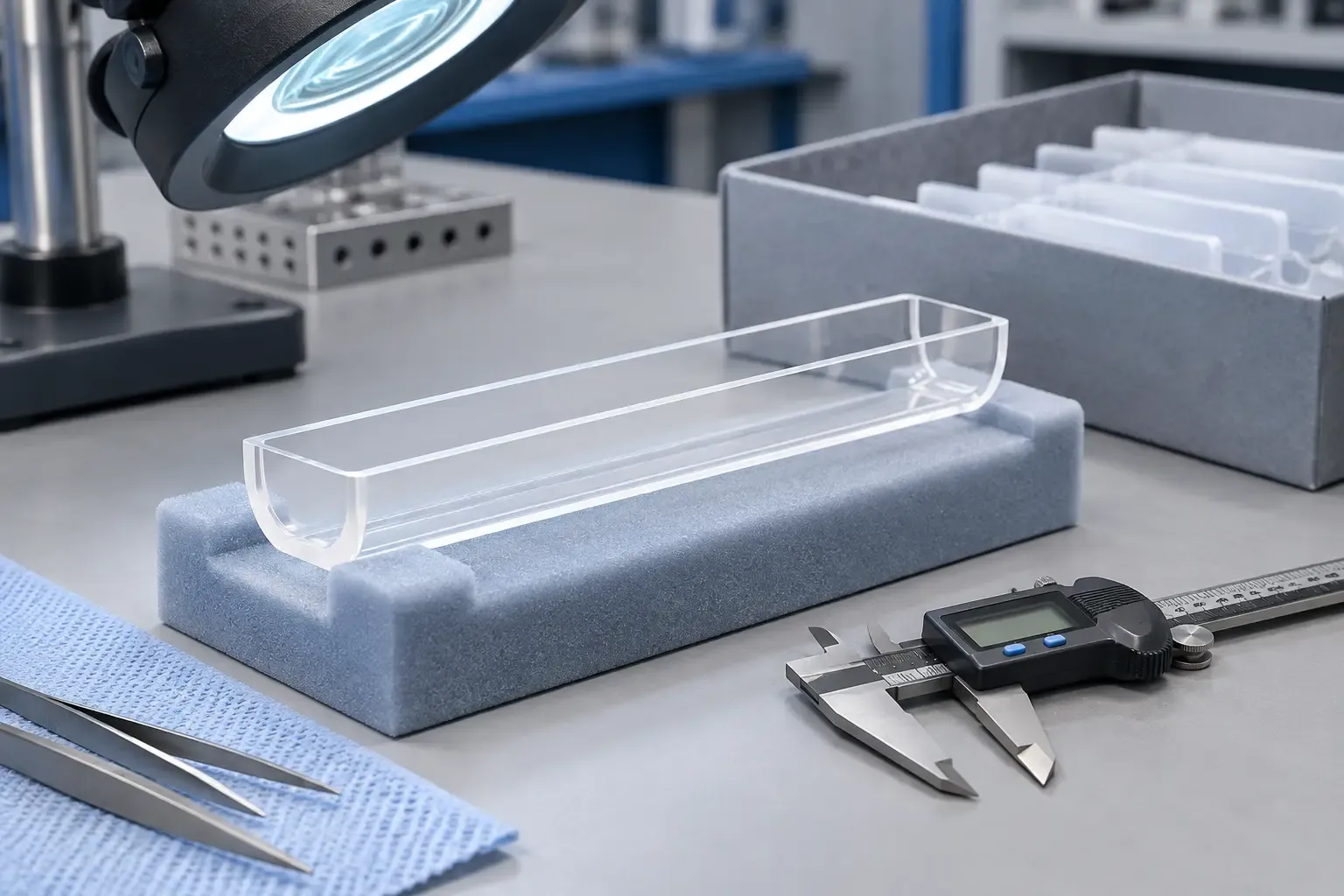
Qualification should separate fit, handling and process observations. Keep the drawing revision, equipment, loading method and inspection criteria fixed while the first article is reviewed. Record any change request against the same part identity so that a successful trial is not accidentally attached to a different geometry.
1. Freeze the inquiry inputs
Confirm wafer details, slot layout, equipment interface, service conditions, surface requirements, tolerances and the evidence expected at delivery.
2. Review the drawing or controlled sketch
Check datums, load direction, contact points, clearances and measurement access. Resolve ambiguous terms before quotation or machining.
3. Inspect the first article at receiving
Compare the part with the approved revision, record dimensions and visual condition, and verify that packaging has not damaged edges or contact areas.
4. Run a controlled equipment trial
Observe loading, unloading, fit, wafer support, process handling and post-cycle condition. Keep the result tied to the exact boat, equipment and process record.
What Are the Common Quartz Boat Specification Mistakes?
The most common mistake is treating a product name as a complete design. Other avoidable errors include omitting the loading path, mixing nominal wafer size with actual thickness tolerance, defining “high purity” without an acceptance basis, and requesting a surface finish without identifying the critical areas. A short RFQ can still be precise if it points to a drawing, a sample, a process envelope and a measurable acceptance plan.
Engineering boundary: A quartz boat description cannot guarantee wafer yield, contamination performance, lifetime or thermal uniformity without the customer’s equipment, process chemistry, cleaning route, loading practice and qualification data. Those outcomes require application-specific validation.
Frequently Asked Questions
What information should I send first for a quartz boat quotation?
Send the wafer or workpiece details, a drawing or controlled sketch, slot count and pitch, equipment interface, service conditions, surface requirements, quantity and inspection expectations. If any field is unknown, mark it as open rather than guessing.
Is a quartz boat specified only by wafer diameter?
No. Diameter is only one input. Thickness range, notch orientation, slot geometry, clearances, loading method, support points and the thermal or chemical process all affect the design review.
Are quartz boats the same as quartz powder products?
No. A quartz boat is a shaped quartzware component. Quartz powder, natural quartz sand, fused silica sand and cristobalite are different material forms or phases with different application roles.
Can a public product page replace a first-article inspection?
No. The product page defines the application scope and the information needed for review. The approved drawing, inspection record and customer-side fit and process trial control release.
Source and Review Boundary
Product scope was checked against Changtong’s public quartz plates and boats product page on September 9, 2026. General process context was checked against the SEMI quartz boat technical guideline and related SEMI quartz-glass machining guidance. External sources provide general engineering context only; they are not Changtong production data, a customer qualification record or a performance guarantee.
Request a Quartz Boat Specification Review
Send the wafer details, controlled drawing or sketch, slot geometry, furnace interface, service conditions, surface requirements, quantity, destination and inspection expectations. Changtong can review the inquiry against the drawing, process envelope and quartzware scope described above.
Send your quartzware requirements