How to Specify 45 μm Sieve Residue for Glass Powder Slab Trials
One historical fused-glass powder sample recorded 14.50% residue above 45 μm. Learn how to turn that result into a buyer-specific sieve specification and controlled slab trial.
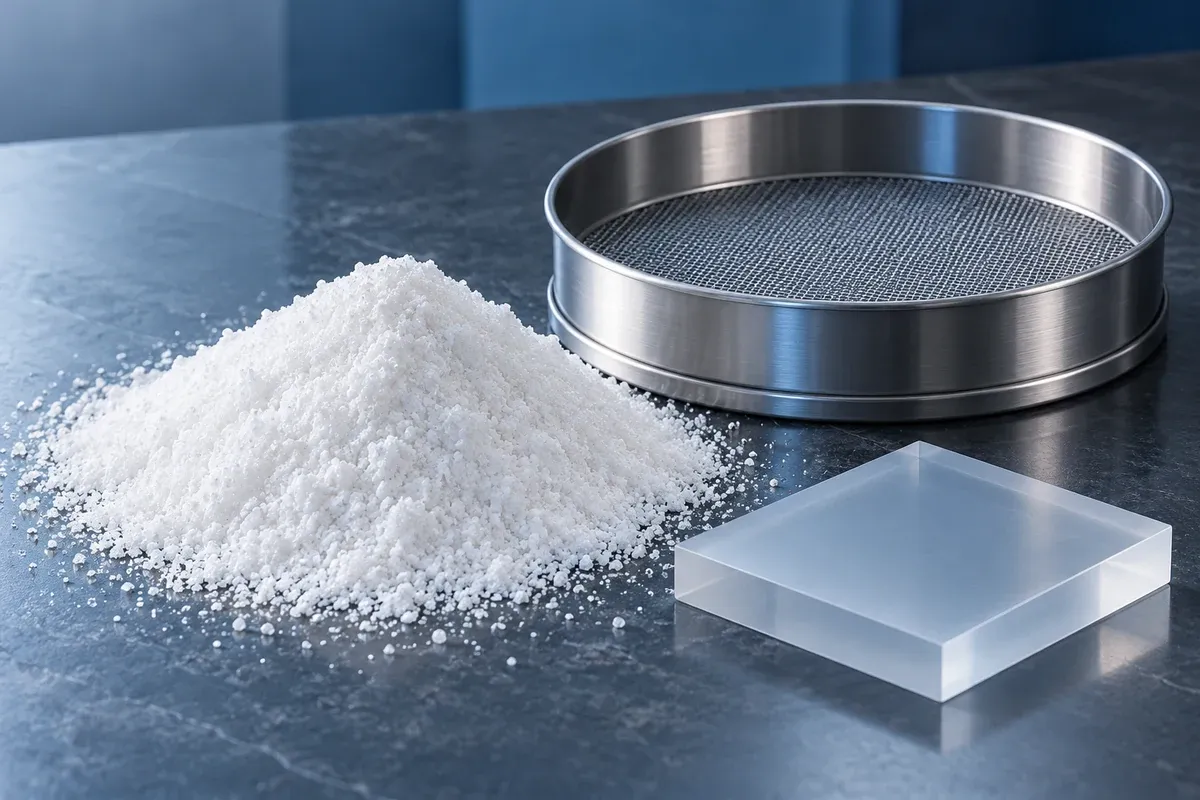
One historical fused-glass powder evaluation records 14.50% residue above 45 μm in a sample labeled <0.045 mm. This result describes that sample only. It does not make the material suitable or unsuitable by itself: the useful target depends on the buyer's aggregate blend, resin process, surface finish and inspection method.
Read the result as a sample-specific distribution question
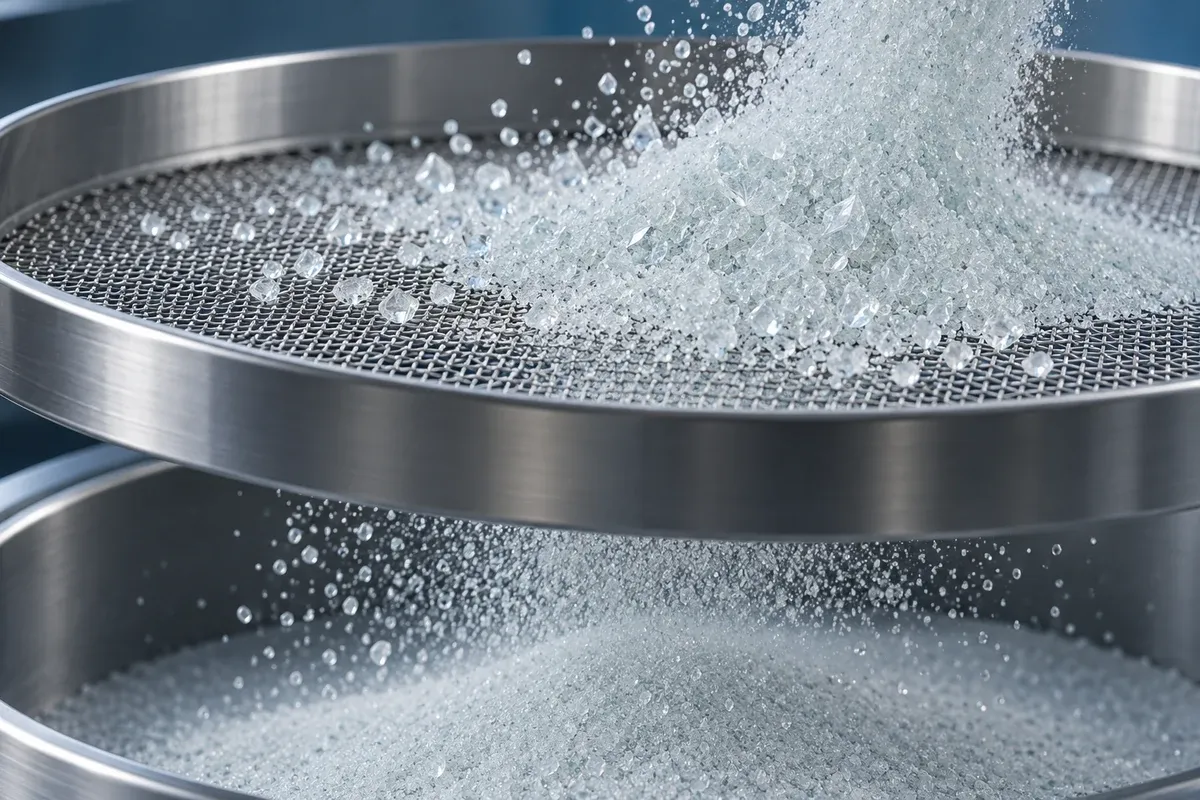
The 14.50% figure is a mass fraction in the report. As a simple unit conversion, it is equivalent to 145 g per kg of sample (0.145 × 1,000 g). This is a derived mass equivalent, not a separate weighing or experiment, and it does not say how many individual particles are coarse. A small number of large grains and many particles near the cut point can have different behavior in a mix even when their mass fractions match.
The reference value should not become a general benchmark. Although 19.97% is numerically higher than 14.50%, a lower residue does not automatically produce the preferred slab. Acceptance depends on the agreed recipe, appearance, processing and inspection criteria.
Set the sieve target for the customer’s recipe
The appropriate residue limit depends on the aggregate blend, resin process and surface requirements. A buyer may set a tighter or broader allowance after evaluating the finished slab. Record the aperture, method, sample mass and accepted range in the contract rather than importing a limit from another project.
What the report leaves open
The report lists ASTM E11 beside the particle-size result. That notation alone does not document the complete test procedure: the supplied page does not establish the sampling plan, sample mass, conditioning, sieve duration, dispersion practice, replicate count, or measurement uncertainty. Nor does it show whether the tested aliquot represents a production lot. Those details matter when deciding whether a coarse tail is persistent, localized, or sensitive to how the sample was prepared.
Do not assume that sampling, dispersion, or operator blinding explains the value; the record does not prove any of those causes. Instead, treat them as questions for a repeat test. Request the sieve stack and apertures, sample mass, preparation and dispersion steps, run time, replicates, raw retained weights, and lot identifier. Ask the lab and supplier to agree on the acceptance basis before comparing new results.
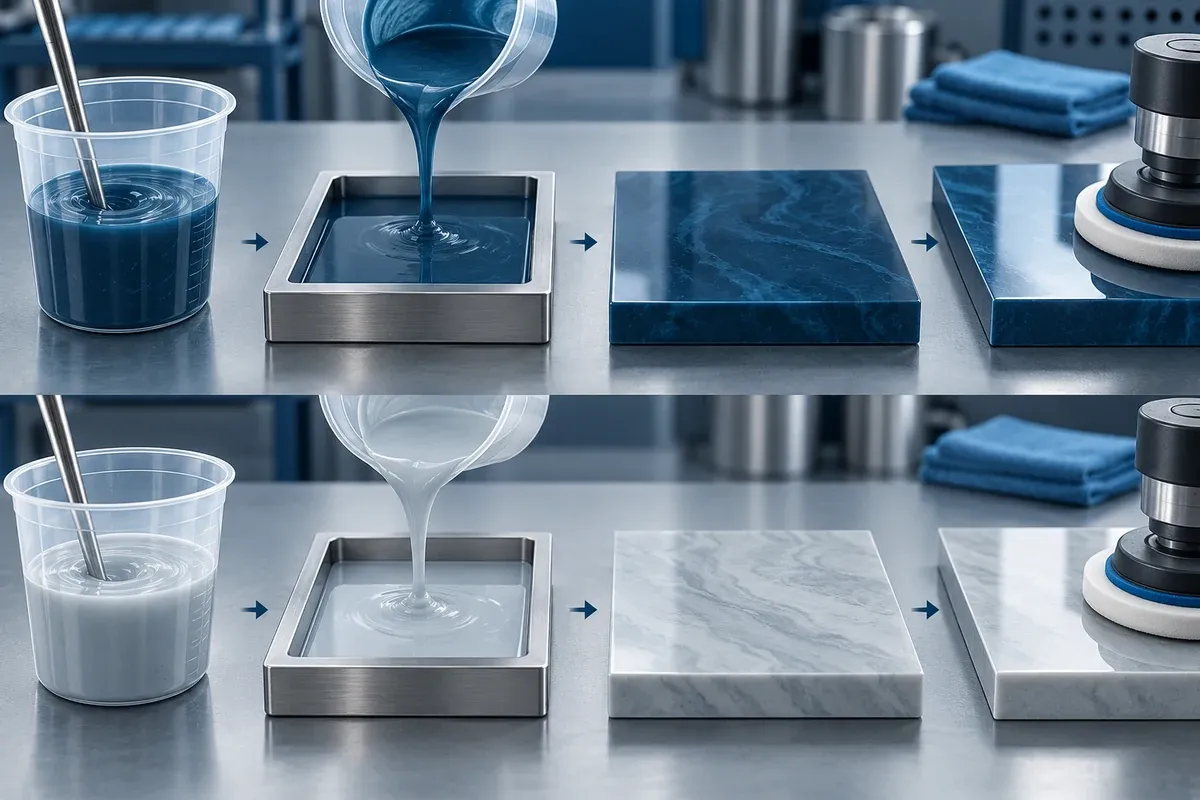
Translate the powder result into a controlled slab trial
A coarse fraction can plausibly affect packing, local resin demand, or the appearance of a polished surface, but those are hypotheses to test, not causal mechanisms demonstrated by this report. The same powder can also behave differently depending on the full aggregate grading, resin system, loading, mixing sequence, pressing, cure, and finishing. A useful next step is a paired trial, not a conclusion drawn from particle size alone.
- Confirm the powder result. Split a traceable lot into representative aliquots and have the agreed method run in replicate. Preserve the retained fractions so the tail can be inspected and weighed.
- Change one variable. Compare the as-received powder with a controlled reclassified or separately screened fraction. Keep the resin, total filler loading, other aggregate fractions, mixing, compaction, cure, and polish sequence fixed.
- Define observations in advance. Record visible pits or pull-outs, gloss, color, and any agreed surface-quality metric at specified locations. Use blinded sample labels if practical, and repeat across slabs before drawing a process conclusion.
- Set acceptance with the buyer. Agree on the particle-size limit, test method, and surface criteria before production release. One slab result would not replace lot-level powder control.
The supplied report also describes one finished formulation with no pits noted and gloss of 30–50 gloss units, while its conclusion separately says the <0.045 mm fraction needs particle-size improvement. Read those statements together: the report documents a formulation observation and a powder-size concern, but it does not isolate the powder tail as the cause of a surface result or prove that the slab failed. That distinction keeps a diagnostic finding useful without overstating it.
Questions to resolve before buying or scaling
Does 14.50% above 45 μm mean every batch will behave the same way?
No. The result applies to the sample described in the supplied report. Lot-to-lot consistency and repeatability need representative sampling and repeated measurements.
Can the report’s reference frit be treated as an acceptable control?
Not against the stated <3.0% limit: its reported 19.97% is also above that threshold. It can be a comparison value, but not evidence of compliance.
Is the powder automatically unsuitable for engineered-stone slabs?
The historical report supports follow-up on its tested sample, not a universal suitability verdict. Evaluate a current lot against the target formulation, buyer-agreed residue range, and controlled slab observations.
Use the result as a trial input
Set the residue target for the customer’s recipe, then verify it with repeatable powder tests and slab trials.
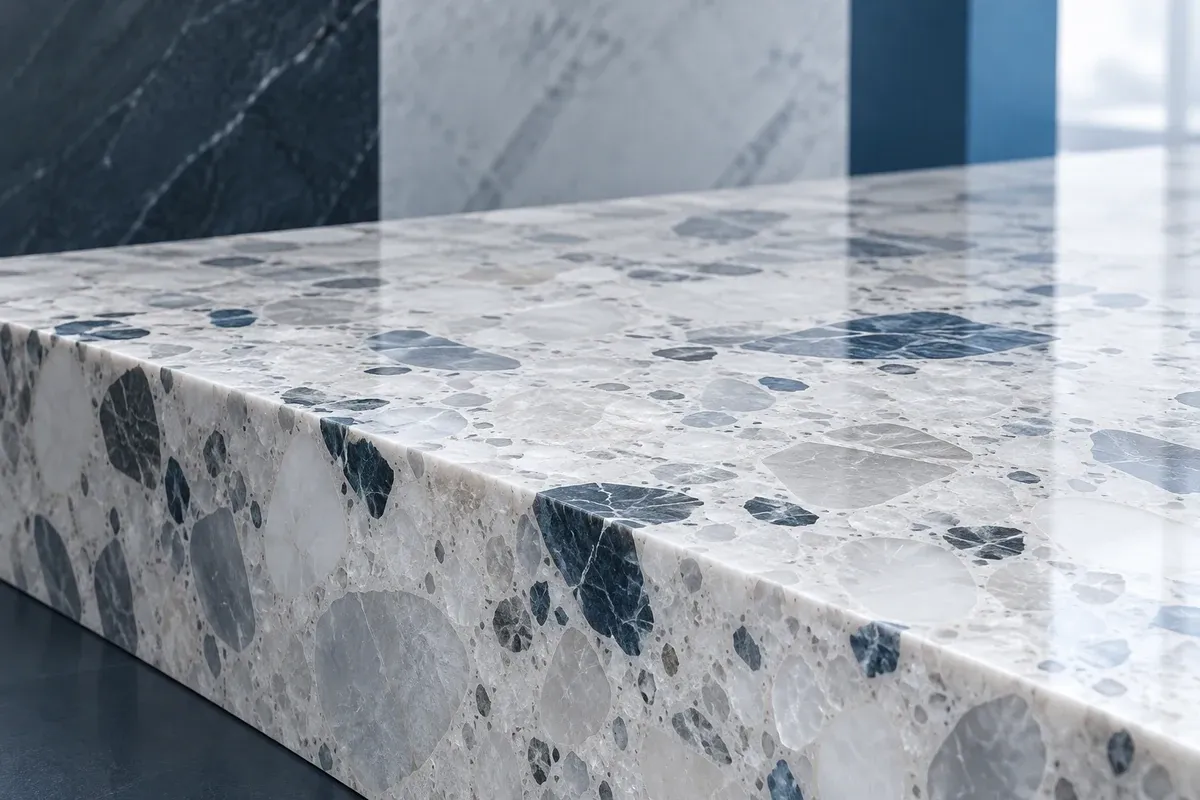
For a formulation discussion, compare the intended grade with amorphous fused glass powder for resin-bound slabs and, where relevant, amorphous fused glass sand for engineered-stone slabs. These product pages are starting points for a technical conversation, not proof that a specific lot meets a buyer’s specification. Contact us with your target grading, test method, resin system, and trial criteria to discuss a traceable evaluation.
Related products
Related technical guides
Request a quote for your slab filler trial
Share your target grading, resin system, intended use and evaluation requirements to prepare a focused request for quote.
Request a quote