Whiteness Drift in Cristobalite and Quartz Fillers: A Root-Cause Worksheet
Investigate silica filler whiteness or colour drift by controlling CIE L*a*b* measurement, sampling, moisture, lot evidence and application trials.
Do not use “white” as the test method
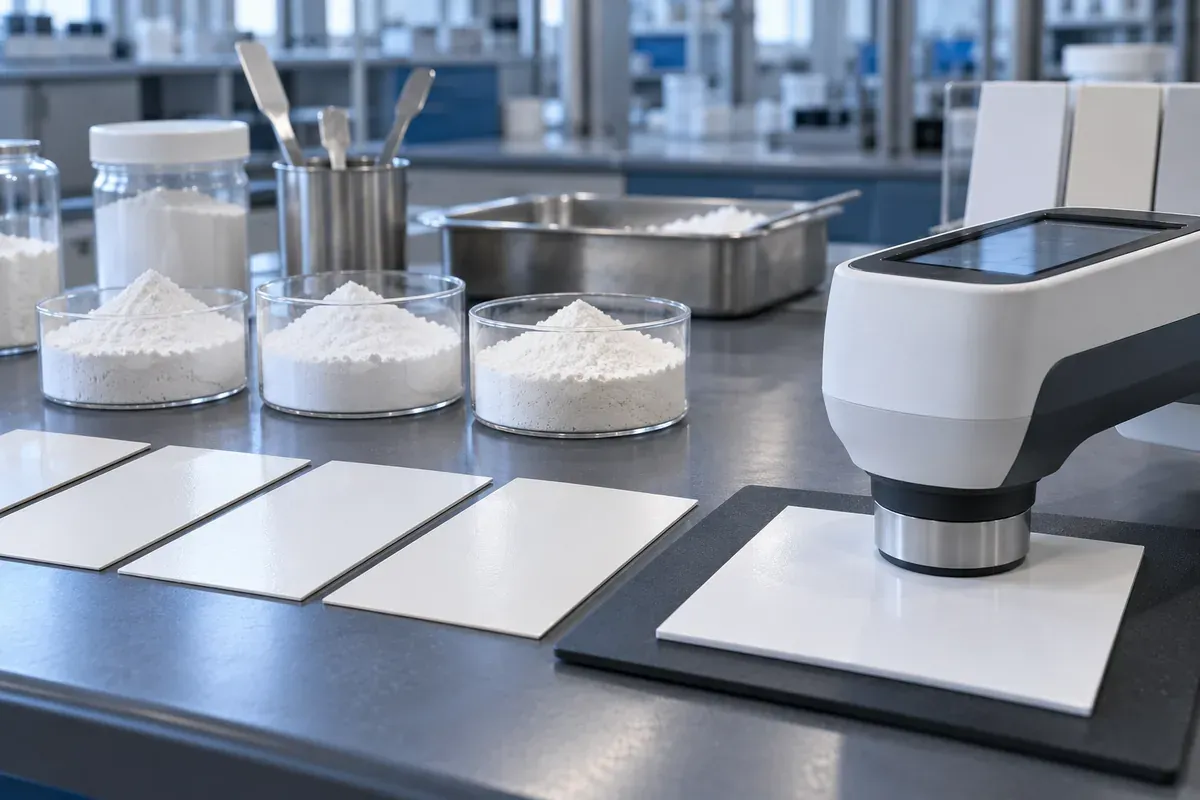
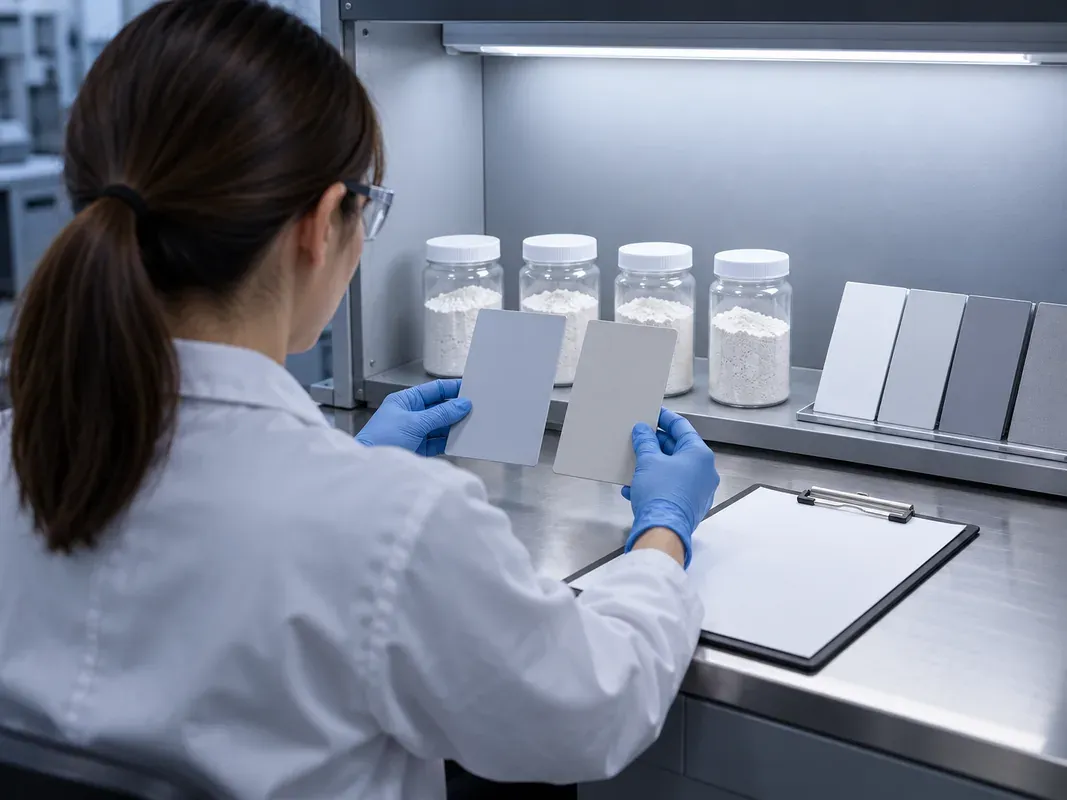
Visual comparison is useful for detecting a change, but it is not a complete acceptance method. Lighting, viewing angle, sample thickness, surface texture and surrounding colours can change what the operator sees. First record whether the complaint concerns the dry powder, a wet compound, a cured part or a fired surface.
Whiteness, brightness and CIE L*a*b* values are related but not interchangeable. ISO/CIE 11664-4 defines calculation of CIE 1976 L*a*b* coordinates, including lightness, chroma and hue correlates. A purchasing specification must still state instrument geometry, illuminant/observer, sample preparation and the agreed calculation.
Confirm the measurement system before the material
| Check | Controlled question | Failure signal |
|---|---|---|
| Instrument | Was the same instrument, calibration tile and method used? | Control standard shifts before the powder is measured. |
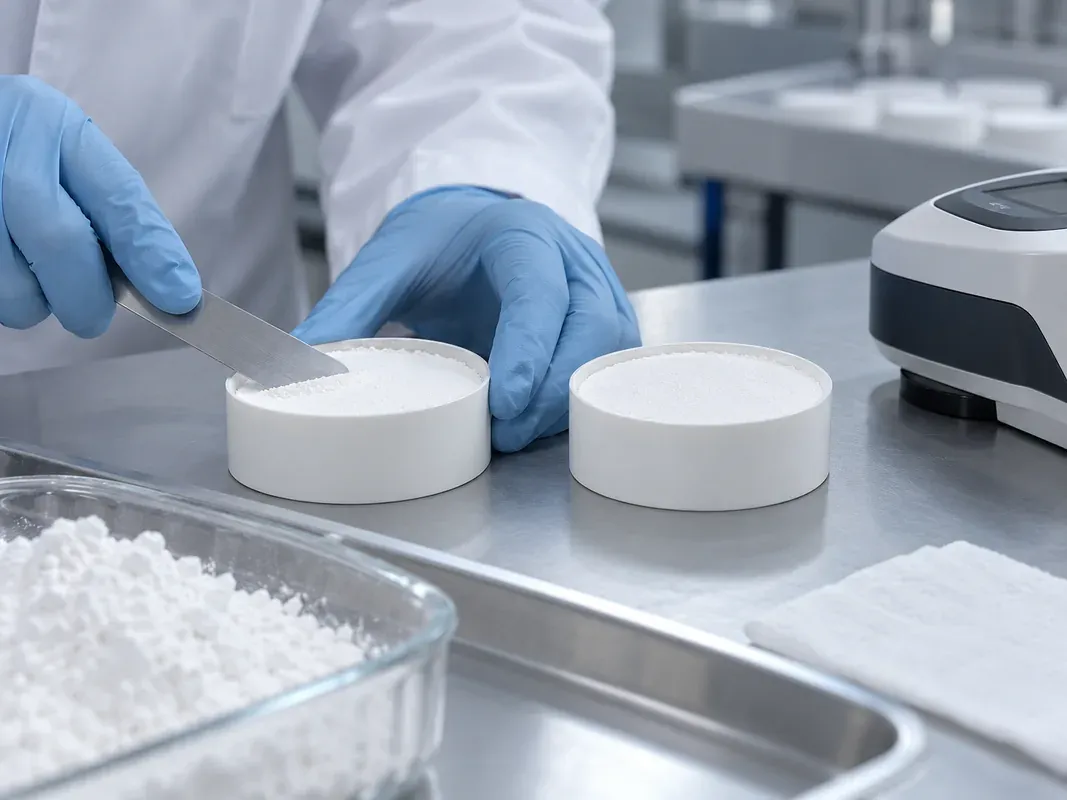
| Sample cup | Are cup, fill depth, compaction and surface leveling identical? | Repeated preparation of one sample gives a wide spread. |
| Conditioning | Were samples equilibrated for time, temperature and humidity? | Result changes after drying or sealed conditioning. |
| Replicates | Were multiple preparations measured rather than one reading? | One outlier drives the disposition. |
| Reference lot | Is an approved retained lot tested in the same session? | Both reference and complaint lot move together. |
Separate lightness, colour direction and finished appearance
L* describes lightness; a* and b* describe opposing colour directions. A higher or lower whiteness number does not tell the full direction of change. Record ΔL*, Δa* and Δb* against the approved retain before calculating any overall colour difference. Do not borrow a universal ΔE pass limit from another product—the visible and functional tolerance depends on pigment level, film thickness, surface texture and customer requirement.
Illustrative data—method demonstration only
If an approved retain measures L* 95.2, a* 0.1 and b* 1.3, while the complaint sample measures L* 94.6, a* 0.1 and b* 1.9, the direct differences are ΔL* −0.6, Δa* 0.0 and Δb* +0.6. That pattern points to a darker and more yellow reading, but it does not identify the cause or set a pass/fail decision. Repeat preparation, compare a second instrument or method where justified, and test the finished formulation.
Investigate powder and handling causes in a fixed order
| Observation | Possible branch | Next controlled check |
|---|---|---|
| Dry powder shifts; retain does not | Lot chemistry, mineral phase, contamination or process variation | Review lot COA, agreed phase evidence and retained sample. |
| Dry powder matches; cured product shifts | Binder, pigment, cure, dispersion, film thickness or substrate | Run A/B formulation with the same non-filler materials. |
| Result changes after drying | Moisture pickup or conditioning difference | Compare sealed and conditioned aliquots using the approved method. |
| Visible specks or streaks | Agglomerates, foreign material, poor dispersion or equipment residue | Inspect sieve/filtration residue and cleanout records. |
| Colour varies across one batch | Sampling or mixing non-uniformity | Take representative increments and map position/time. |
Use the product grade as context, not proof
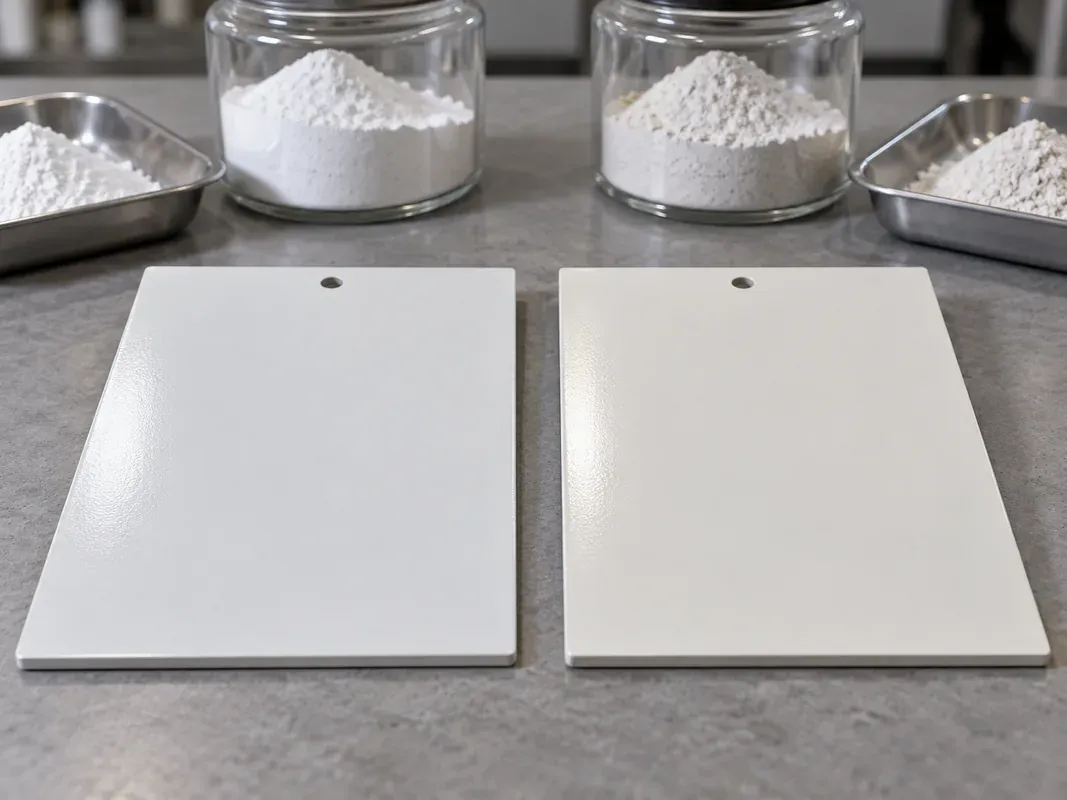
For pale coatings or compounds, buyers may start with the High-Whiteness Cristobalite Powder range or a published crystalline silica filler for paint formulations. These pages identify candidate product families; the current TDS/COA and agreed measurement method govern a specific order.
Material identity must remain clear. High-whiteness cristobalite is a crystalline silica phase produced by controlled calcination. Ground crystalline quartz and amorphous fused silica are different materials. Do not substitute one to chase a colour number without requalifying the formulation.
Turn the investigation into a disposition record
Record the complaint sample identity, seal condition, sampling location, instrument/method, replicate results, retain comparison and finished-product trial. Classify the outcome as measurement variation, handling/storage, material difference, formulation/process difference or unresolved. An unresolved result should remain on hold rather than being forced into a supplier or plant cause.
FAQ
Is whiteness the same as L*?
No. L* is the lightness coordinate in CIE L*a*b*. Whiteness is a calculated index whose formula and conditions must be specified.
Can iron content explain every yellow shift?
No. Chemistry may be one branch, but moisture, sample preparation, binder colour, pigment, cure and contamination must also be controlled.
Should we reject a lot after one low reading?
Not without following the agreed sampling and test method. Confirm calibration, prepare replicates and compare the approved retain before disposition.
Define a colour-control request
Send the application, material phase, current method, target values, sample preparation and finished-product acceptance test. Changtong can review a candidate grade and lot-document scope.
Contact Changtong