Engineered Quartz Stone Raw-Material Matching: Filler, Aggregate, and COA Controls
A practical buyer guide to matching fine silica filler and graded quartz aggregates for engineered quartz stone, using PSD, phase, color, moisture and lot records.
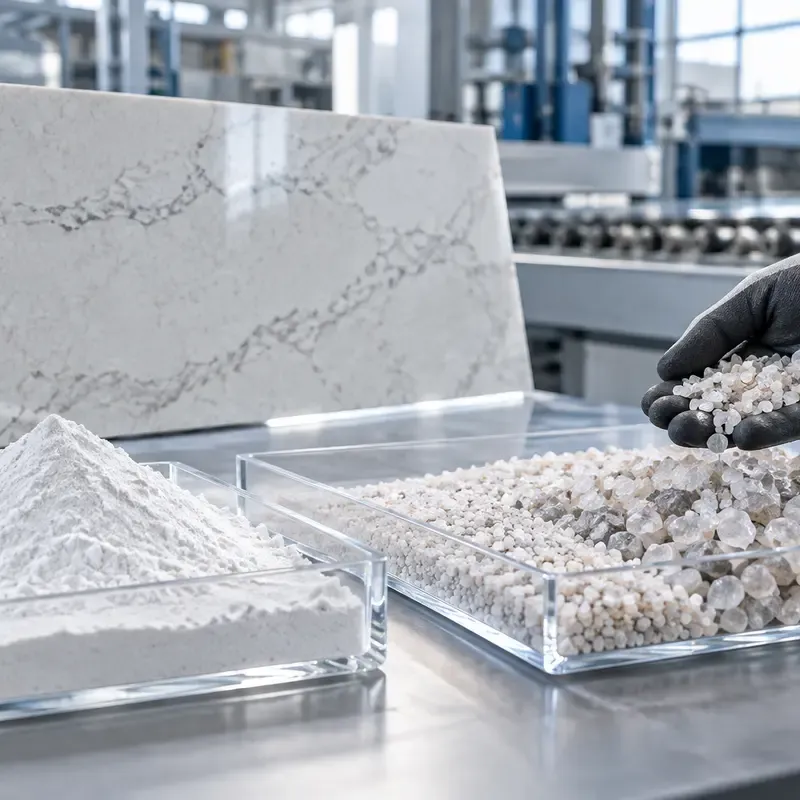
Engineered quartz stone performance is often decided before mixing begins. Fine filler, graded aggregate, phase identity, color, moisture, and lot records should be qualified as one raw-material system rather than approved from a single headline value.
This guide is a screening framework for engineered quartz stone manufacturers and buyers. Acceptance limits must be set against the actual resin, pigment, press, curing route, polishing process, and product series. The examples below are qualification questions, not Changtong guaranteed finished-slab performance.
In engineered quartz stone, a mineral package does more than occupy volume. Its particle-size distribution, phase identity, surface cleanliness, color, moisture, and lot-to-lot consistency affect mixing, wetting, pressing, curing, polishing, and the visual result. That is why a supplier comparison based only on “silica filler” or “quartz aggregate” can lead to the wrong trial design.
A more useful purchasing process separates the roles of fine filler and coarse aggregate, then reconnects them through a controlled formulation trial. The objective is not to choose the material with the most impressive single number. It is to identify a repeatable raw-material window that the plant can verify and reproduce.
1. Define the role of each mineral fraction
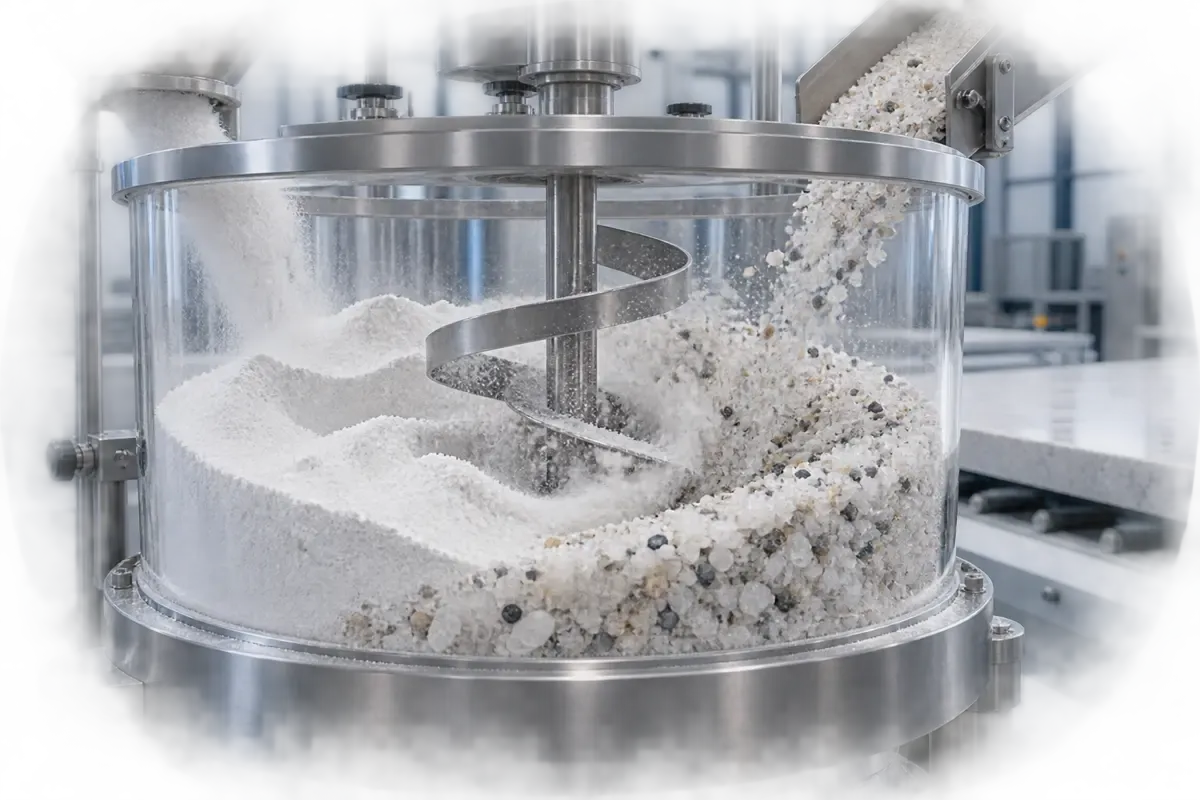
Fine silica filler and graded quartz aggregate may both be mineral materials, but they do different jobs in a slab recipe. Fine particles influence the spaces between larger grains, resin wetting, paste workability, pigment distribution, and the surface exposed during polishing. Aggregate provides the visible mineral skeleton and contributes to the packing structure of the pressed body.
When a supplier proposes a “matched package,” ask what is actually matched: phase, color, size curve, moisture, chemistry, packaging, or only the product name. A package is useful only when its acceptance criteria are written into the trial record and can be checked against each incoming lot.
2. Treat color as a formulation variable
Whiteness and trace-element chemistry can influence the visual starting point of a white or light-colored engineered stone series. However, powder color is not the same as finished-slab whiteness. Resin tone, pigment package, curing conditions, surface polishing, and the combination of mineral fractions also affect the final appearance.
For that reason, do not convert an L* value or an iron result into a guaranteed pigment or titanium-dioxide saving. Use the supplier’s reported method, reference sample, and lot history to define a screening range, then compare molded plaques or slabs made with the actual production system.
3. Build the particle-size question around packing
Particle-size data are meaningful only when the test method, sieve series, sampling procedure, and reporting format are known. A nominal mesh label alone does not show how much material sits in each fraction. Two products carrying similar commercial descriptions can behave differently if their tails, fines, or particle shapes differ.

During trials, record more than resin demand. Observe wetting time, mixing torque or load, de-airing behavior, press filling, green-body integrity, edge chipping, polishing response, and surface pinholes. These observations connect the PSD record to the manufacturing decision without pretending that one distribution guarantees one result.
| Qualification item | What to request | Why it matters |
|---|---|---|
| Particle size | Method, fractions, curve or sieve report | Links packing and workability to a measurable lot record |
| Color and chemistry | Method, reference, and trace-element results where relevant | Supports visual consistency and pigment-trial decisions |
| Moisture | Test basis, sampling point, and agreed limit | Helps control wetting, storage, and process variability |
4. Compare quartz and cristobalite by phase, not by label
Ground quartz and cristobalite are different silica phase identities. They should not be treated as interchangeable because both may be sold as white mineral powders. Confirm the phase using the current technical data and, where the application requires it, an XRD-based verification approach.
Thermal history, post-curing, cutting, polishing, and the customer’s service conditions can change the relevance of phase selection. The correct question is therefore not “which phase is always better?” but “which phase is approved for this product series, process window, and end-use requirement?”
5. Turn the COA into a release checklist
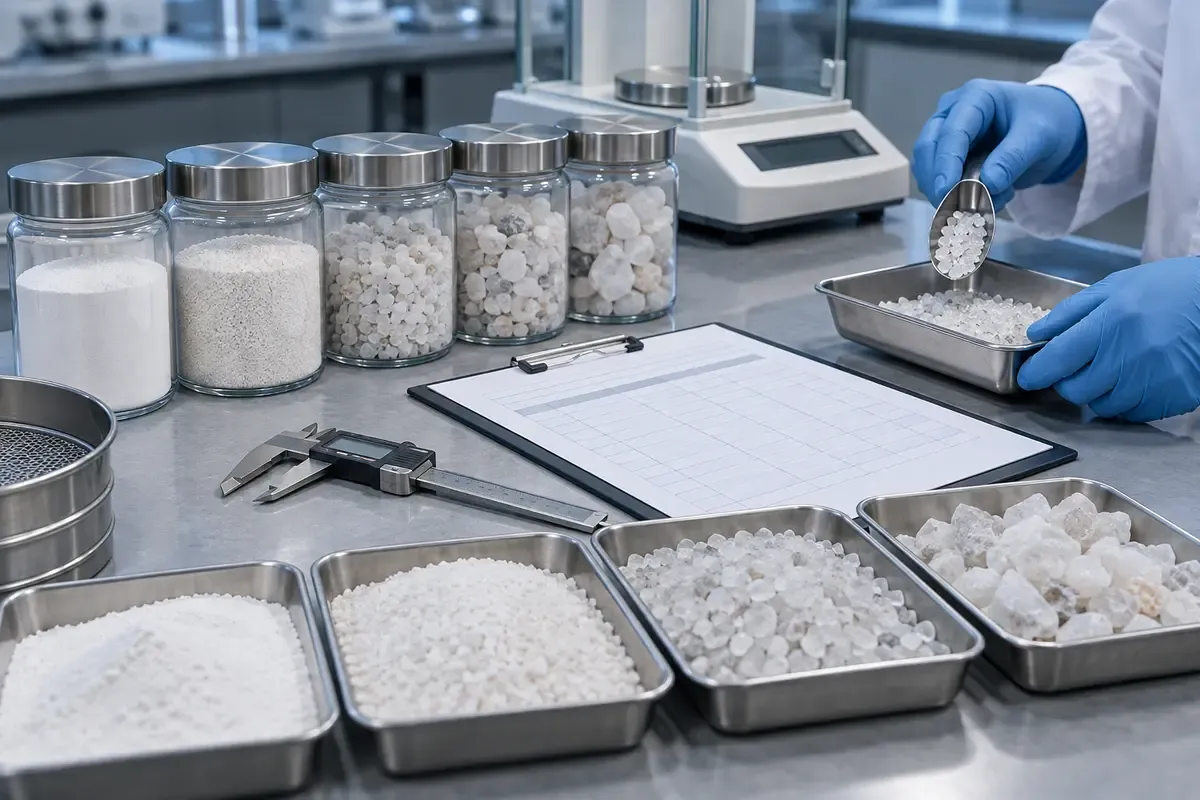
A useful COA review is a traceability exercise, not a search for a single pass/fail number. Before approving a new source or a new lot, confirm the material identity, phase, particle-size method, moisture basis, color or whiteness method, relevant chemistry, lot number, packaging, storage condition, and relationship to the submitted sample.
If a destination market needs additional documentation or third-party testing, specify that requirement before the quotation and trial. Do not assume that a general quality statement is equivalent to a product-specific certificate, and do not publish ISO, SGS, RoHS, or other compliance claims unless the corresponding document has been verified for the actual material.
6. Use a staged trial instead of changing everything at once
- Lock the baseline. Record the current resin, pigment, mineral fractions, mixing sequence, pressing conditions, cure schedule, and polishing route.
- Change one material variable. Compare the candidate filler or aggregate while holding the rest of the recipe as stable as practical.
- Record process evidence. Note wetting, torque, air release, press behavior, green strength, edge quality, polishing, and appearance.
- Confirm repeatability. Repeat with more than one lot or production-scale sample before converting a trial observation into a purchasing specification.
Common purchasing mistakes
- Approving a powder from mesh name alone.
- Comparing color values measured by different methods as if they were equivalent.
- Assuming low moisture, high whiteness, or a stated phase guarantees a finished-slab result.
- Changing filler and aggregate together, then being unable to identify the cause of a process change.
- Linking to an unpublished product page or using a product image as an article image without checking its status and reuse history.
FAQ
Is a finer silica filler always better for engineered quartz stone?
No. Finer material may change wetting, surface area, packing, and resin demand. The useful range depends on the complete formulation and process window.
Can quartz and cristobalite be substituted without a new trial?
They are different phases. Any substitution should be reviewed against the approved formulation, thermal history, processing route, and end-use requirements.
What should a buyer request before placing a trial order?
Request the current TDS and COA format, phase identity, PSD method, moisture basis, color method, lot traceability, packaging details, and any destination-specific documents.
Where should the trial start?
Start with a controlled lab or pilot comparison using the actual resin and mineral package, then confirm the observation at the relevant production scale.
Need a raw-material matching discussion?
Share your target product series, mineral fractions, PSD method, phase requirement, resin system, and trial objective with the Changtong technical team.
Contact Changtong Technical TeamRelated references: graded natural quartz sand reference; cristobalite XRD verification guide; high-whiteness cristobalite material reference.
Technical note: public references and supplier documents support the qualification logic described here. They do not represent Changtong finished-slab test results or a universal formulation recommendation.