Fused Silica Firing Atmosphere: A Devitrification Comparison for Ceramic Buyers
Qualify fused silica after ceramic firing by comparing atmosphere, surface condition and cristobalite formation under the customer’s temperature-time schedule.
Industrial application guide · Technical review ·
Fused Silica Firing Atmosphere: A Devitrification Comparison for Ceramic Buyers
An amorphous incoming powder can develop cristobalite during ceramic processing. Buyers should ask how the candidate behaves under the actual heat-treatment atmosphere and surface condition, rather than relying on the unfired phase result alone.
What the published evidence establishes
Shmueli, Polishchuk, Katsman and Pokroy studied high-purity amorphous silica with different particle fractions under static gas atmospheres. The 2025 research compared medical air, nitrogen and forming gas containing 95% N₂/5% H₂. The institutional abstract reports inhibition of crystallization associated with surface-hydroxyl removal, a DSC onset near 1280°C, and a correlation between specific surface area and cristobalite content. Crystallization proceeded rapidly above the reported threshold despite atmosphere changes. Synchrotron XRD, DSC and XPS supported the investigation. [1]
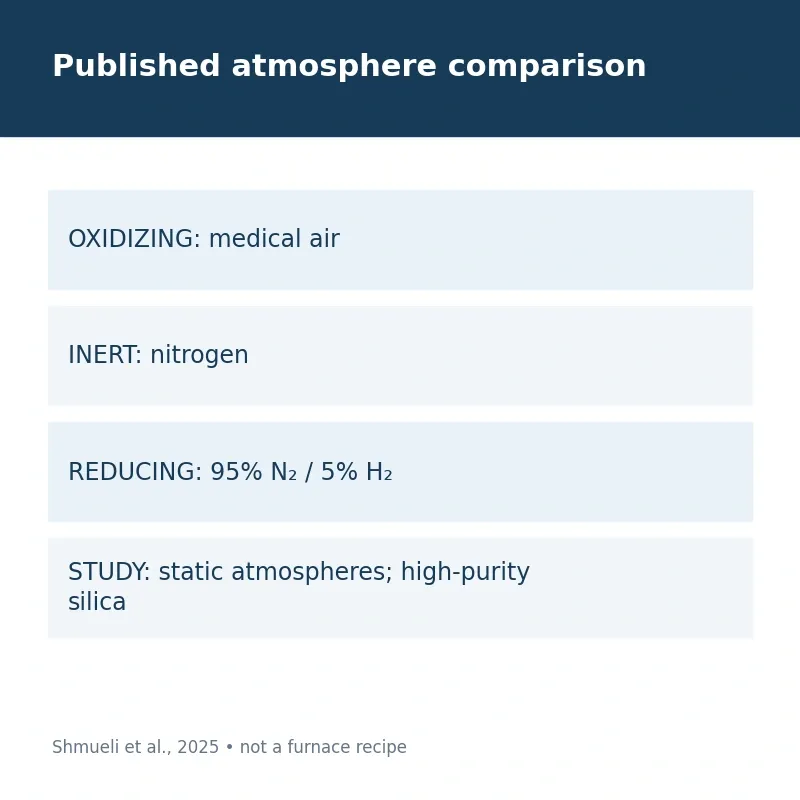
Turn atmosphere into a recorded trial variable
Start with the buyer’s approved furnace process and preserve the control material. Record actual temperature history, dwell, cooling, specimen geometry and atmosphere conditions. Gas composition alone does not define the furnace environment; the customer should document the process parameters needed to reproduce it. The cited reducing atmosphere is a research condition, not a recommendation to modify an industrial furnace or introduce hydrogen without a qualified procedure.
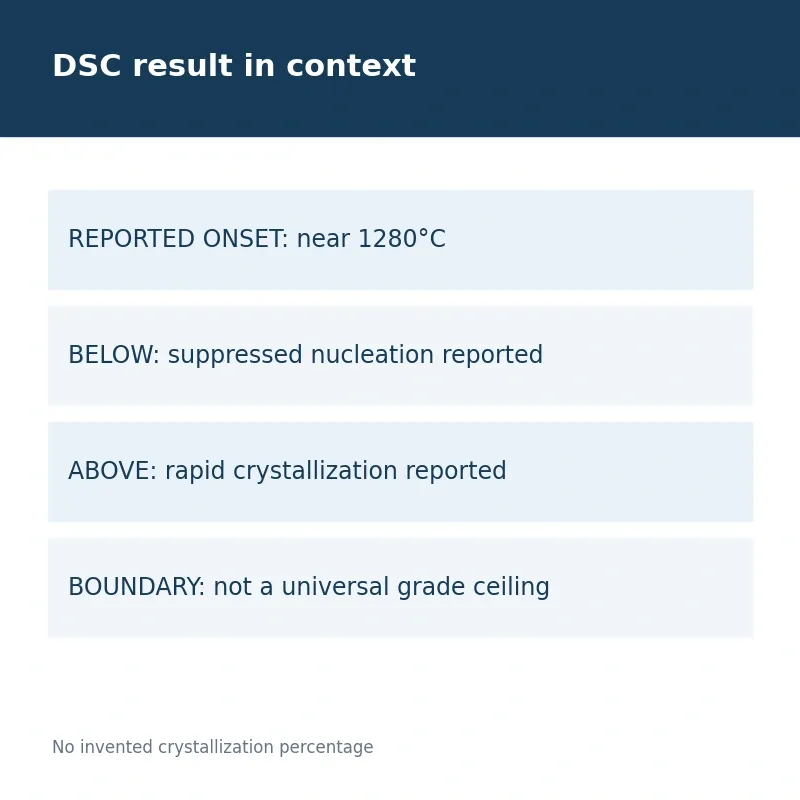
Compare phase after the complete process
Sample incoming powder, representative fired material and, where relevant, material after additional service-equivalent exposure. Use a documented phase-analysis method with consistent preparation and reporting. If a quantified crystalline fraction is required, agree the analytical method and reporting limit beforehand. A simple presence/absence statement and a calibrated phase fraction answer different procurement questions.
Separate surface chemistry from particle size alone
The study gives buyers a reason to request specific-surface-area information as well as PSD when devitrification is a concern. Do not assume that two powders with similar median particle size have equivalent surface histories. Record storage, drying and binder contact during the trial. Use additional surface characterization only when it resolves a defined problem; an expensive method is not a substitute for a matched process comparison.
| Comparison | Record to retain | Decision use |
|---|---|---|
| Process match | Temperature/dwell, atmosphere and specimen history | Avoid transferring a static-gas result directly |
| Phase assessment | Incoming and fired XRD with reporting convention | Verify conversion under the actual process |
| Part acceptance | Dimensions, strength or cycle retention | Link phase behavior to a useful property |
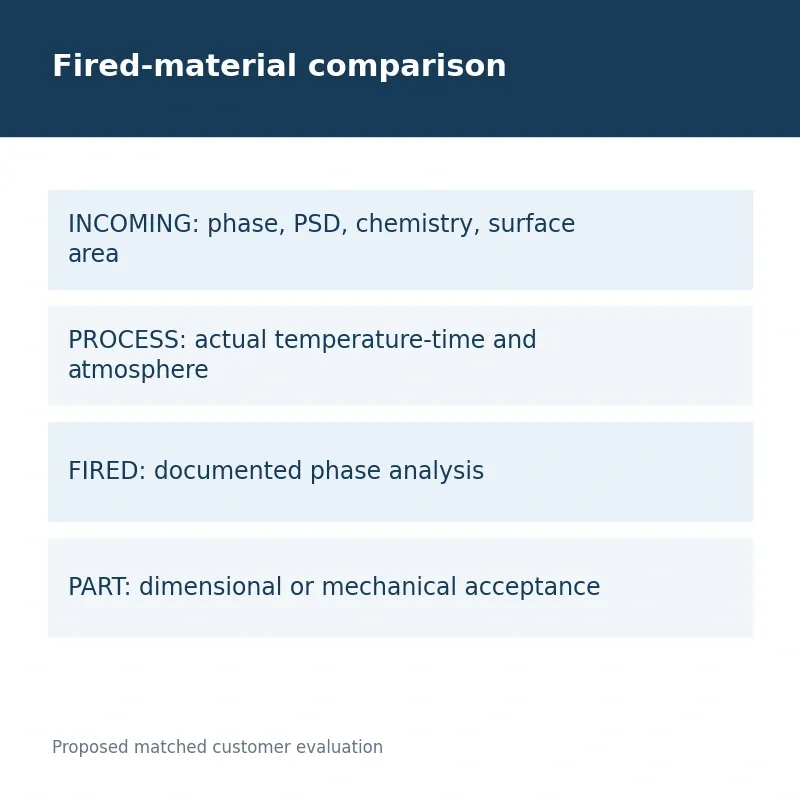
Link phase change to the part requirement
Measure the ceramic property that drives acceptance: dimensions, strength, expansion or thermal-cycle retention, as appropriate to the part. A lower crystalline fraction is meaningful only in relation to that requirement. The reported DSC onset cannot be used as a universal safe-temperature ceiling for every fused-silica grade, additive package or dwell time. Request application evidence under the customer’s schedule before selecting a production lot.
Evidence boundary: Published research is an industry reference, not Changtong test data or a product guarantee. Recent background, published in 2025, not a new October 2026 paper. Institutional publication record and abstract reviewed; detailed treatment durations and particle fractions were not verified.
Frequently asked questions
Is 1280°C a universal limit?
No. It is a reported DSC onset in one investigation. Purity, surface condition, additives and thermal history can change behavior.
Should buyers copy the forming-gas condition?
No. Treat it as research evidence. Furnace-atmosphere changes belong to a qualified process review with the equipment owner.
For candidate material discussions, review Amorphous fused quartz flour for ceramic feedstock trials. Product availability and application fit require current documentation and customer qualification.
Request an application-specific trial discussion
Provide the ceramic formulation, forming route, binder/debinding history, qualified atmosphere, temperature-time schedule and part acceptance tests. Request current phase, PSD, chemistry and available surface-area data.
Discuss a documented material trialReference and review scope
[1] Shmueli, Z.; Polishchuk, I.; Katsman, A.; Pokroy, B. Controlling cristobalite formation in fused silica via particle size and treatment atmosphere adjustment during ceramic processing. Ceramics International 51(26PA), 48735–48746 (November 2025). DOI: 10.1016/j.ceramint.2025.08.124. Peer-reviewed journal article. Recent background, published in 2025, not a new October 2026 paper. Institutional publication record and abstract reviewed; detailed treatment durations and particle fractions were not verified. Source checked 9 October 2026. All numeric figures are reference values, with their original material context.
Cover: AI-generated application illustration, not a photograph of Changtong production or an experimental result. Body figures are original evidence summaries and proposed comparison plans.