How to Qualify Cristobalite for Silicone Rubber Extrusion
A practical method for qualifying M4000 calcined cristobalite in silicone rubber extrusion through powder evidence, process-window trials and finished-profile tests.
Silicone Rubber Extrusion Guide
A powder can look acceptable on a certificate and still make an extrusion trial difficult. The usual warning signs are rising head pressure, unstable profile dimensions, rough edges, streaks, or a compound that behaves well on the mill but changes after post-cure. Qualifying calcined cristobalite for silicone rubber extrusion therefore requires more than checking SiO2 and a single particle-size value.
This guide shows how to evaluate Changtong M4000 as a mineral-filler component in high-consistency silicone rubber (HCR) extrusion. It uses documented M4000 data to define the powder starting point, then separates those facts from the processing and finished-part results that must be measured in the customer's own formulation.
The real question is not “Will it extrude?”
Most silicone compounds can be pushed through a die if speed and temperature are adjusted far enough. That is not a useful qualification standard. A production team needs to know whether the candidate filler can run inside an economically stable process window while the finished profile stays within dimensional and performance limits.
High-consistency silicone is viscoelastic. Material leaving a die can recover elastically, so the profile may become larger or change shape after exit. Research on HCR extrusion also shows that die geometry, back pressure, compound viscosity and flow stability interact. Those findings do not predict the behaviour of M4000, but they explain why two compounds with similar laboratory hardness can behave differently on the same line.
For that reason, a useful trial does not ask for a single “extrudability” score. It establishes a baseline recipe and compares measurable changes at the mixer, extruder, curing tunnel and inspection bench.
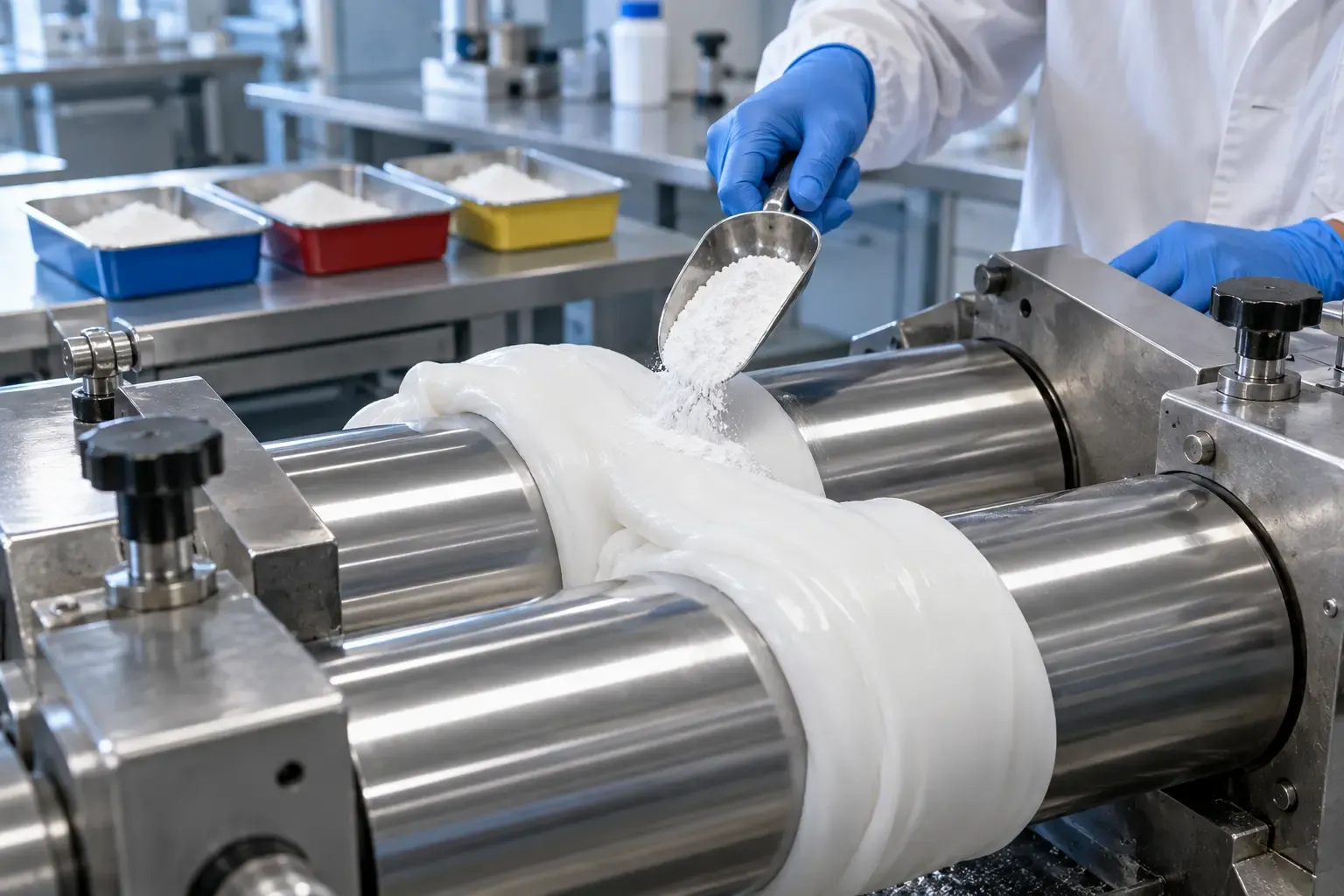
M4000 values that should be locked before the extrusion trial
Changtong's inspection report dated 20 August 2026 identifies sample 260820-1 and cites SJ/T 10675-2002. The values below describe that tested sample; they are not permanent guarantees for every shipment. A current lot COA and the agreed test method should control purchase acceptance.
| Reported property | Sample 260820-1 | Why an extrusion team records it |
|---|---|---|
| Median particle size, d(0.5) | 6.15 µm | Creates a lot-specific reference for dispersion and surface-finish comparisons; it does not describe the complete size distribution. |
| Moisture | 0.1% | Provides an incoming-material baseline when checking storage, cure consistency and volatile-related surface defects. |
| pH | 7.8 | Useful as a consistency check when a cure package may be sensitive to changes in filler condition. |
| Specific gravity | 2.35 g/cm3 | Needed when converting a mass-based recipe to volume fraction and when comparing compound density. |
| Activation | 95% | A reported screening value that requires confirmation of the current method and surface-treatment declaration before it becomes contractual. |
Build a trial matrix that can reveal a process window
A common trial failure starts before the extruder: too many variables are changed at once. If the filler ratio, mixing time, peroxide level, screw speed and die temperature all move together, a smoother profile may be encouraging, but the cause is unknowable.
Start with the existing production compound as the control. Keep the silicone gum, reinforcing silica, plasticizer or process aid, pigment, cure package and mixing sequence fixed. Then introduce M4000 at staged levels as a candidate component of the filler system. It should not be assumed to replace precipitated or fumed silica one-for-one because those amorphous reinforcing silicas have different structure, surface area and network behaviour.
| Trial set | What changes | What stays fixed | Decision purpose |
|---|---|---|---|
| Control | Nothing | Approved production recipe and conditions | Defines normal pressure, output, swell, surface and cured properties. |
| Low introduction | Small, documented M4000 addition or substitution step | Batch size, order of addition, cure package and line settings | Detects early changes without hiding them inside a large formulation move. |
| Intermediate step | Second pre-agreed M4000 level | Same control factors | Checks whether trends are gradual or whether a threshold appears. |
| Confirmation batch | Best candidate repeated | Full recorded method | Separates a reproducible result from a single good run. |
What to record at the mill and extruder
Watch incorporation, not just total mixing time
Record the order and time at which the powder enters the rubber, the number of cuts or passes, roll temperature, roll gap and whether loose powder remains. Note banding, edge cracking, sticking and visible specks. A fixed time has little value if the addition sequence changes.
Capture pressure, output and temperature together
Head pressure by itself can be misleading. Log screw speed, compound temperature, die temperature, line speed and mass output at the same moment. A lower pressure obtained by reducing output is not automatically an improvement.
Measure recovery after a fixed delay
Compare die dimensions with the hot profile, then measure again after cooling and after post-cure when applicable. Use the same time and location each time. This separates immediate die swell from later cure or thermal dimensional change.
Inspect the surface under controlled light
Look for longitudinal lines, torn edges, dull patches, agglomerates, bubbles and pigment streaks. Keep camera angle and lighting constant. Surface appearance is a production result, not something that can be inferred from the powder's median size alone.
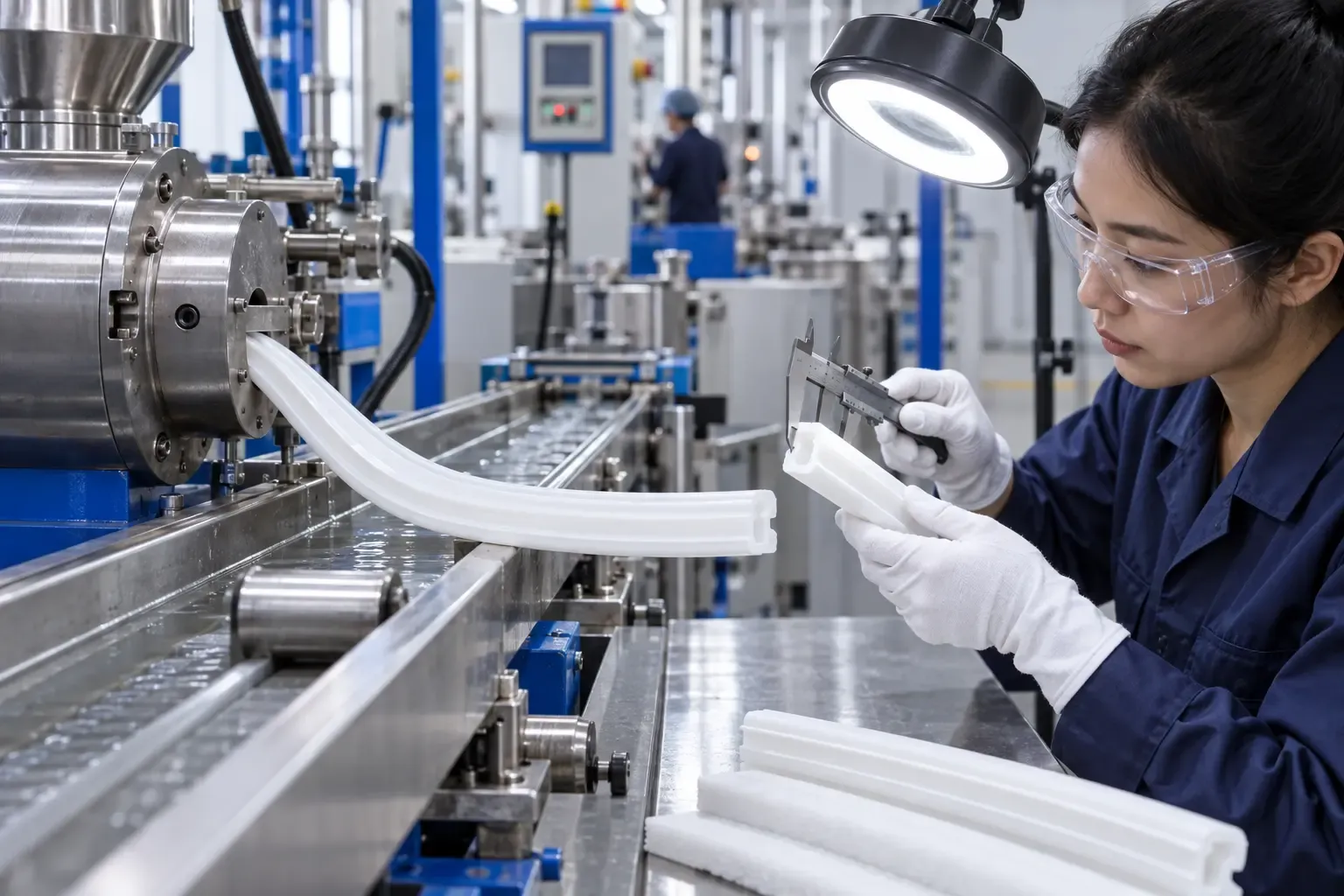
Separate four symptoms that are often blamed on the filler
| Observed symptom | Powder-related checks | Process or formulation checks |
|---|---|---|
| Rising head pressure | Lot identity, moisture, dispersion, agglomerates, addition level | Compound age, screw and screen condition, temperature, output target, die restriction |
| Rough or streaked surface | Dispersion, contamination, coarse tail, powder feeding | Mill history, pigment dispersion, die deposits, scorch, line speed |
| Variable profile size | Compound density and filler ratio consistency | Die swell, temperature stability, puller speed, cure state, post-cure shrinkage |
| Bubbles or porosity | Incoming moisture and storage history | Trapped air, volatile additives, cure conditions, profile thickness and oven balance |
This diagnostic split matters commercially. Rejecting a mineral grade because of a dirty die, aged compound or unstable oven wastes time; approving it after a single cosmetically good run carries the opposite risk.
Do not approve the filler at the die exit
The extrudate must still meet the finished-product specification. The appropriate test plan depends on whether the part is a hose, seal, roller covering, wire component or general profile. Typical comparisons include Shore hardness, tensile strength, elongation, tear strength, compression set, density, cure state, colour and heat ageing. ASTM D2240 describes durometer hardness measurements, while ASTM D412 covers tensile properties of vulcanized rubber and thermoplastic elastomers. These are examples of recognised methods, not mandatory specifications for every customer.
If electrical, food-contact, medical, flame, low-compression-set or volatile limits apply, add the relevant customer-approved methods. M4000 powder chemistry cannot establish regulatory compliance of a finished silicone article.
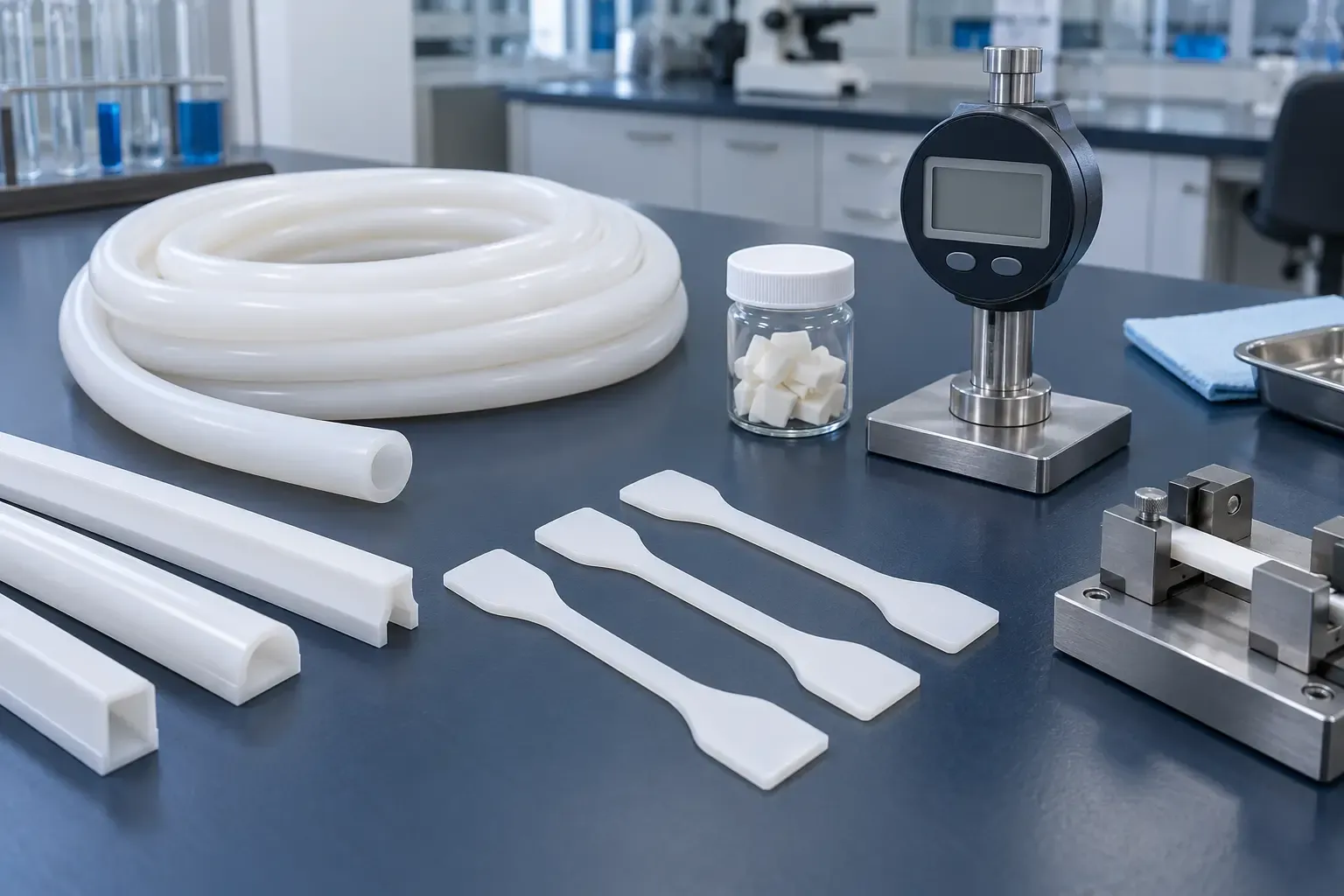
A practical approval sheet for purchasing and production
| Gate | Minimum record | Release decision |
|---|---|---|
| Incoming powder | Current COA, lot number, material identity, moisture, particle-size method, packaging condition | Matches agreed incoming limits and evidence scope. |
| Compounding | Recipe revision, actual weights, addition sequence, mill settings, operator notes | No uncontrolled change or unresolved dispersion issue. |
| Extrusion | Pressure, temperature, speed, output, profile dimensions, surface images | Stable operating window at required output. |
| Cured profile | Dimensions after cure/post-cure, appearance, required physical and ageing tests | Meets the customer's finished-part specification. |
| Repeatability | Repeated candidate batch and retained sample references | Result is reproducible before commercial conversion. |
Buyers who need a broader explanation of filler compatibility can review Changtong's silica powder guide for rubber and resin compounds. For the material and available documented data, see M4000 calcined cristobalite powder for silicone rubber. The earlier cristobalite versus precipitated silica article explains why any substitution study must preserve the reinforcing-filler boundary.
Frequently asked questions
Is a 6.15 µm median size enough to predict extrusion quality?
No. It is a useful batch reference, but extrusion also depends on the distribution tail, agglomeration, surface condition, formulation, mixing history, die geometry and line settings. Confirm the complete PSD method and perform a controlled line trial.
Can M4000 replace all reinforcing silica in an HCR extrusion compound?
That should not be assumed. Calcined cristobalite is a crystalline mineral filler, while precipitated and fumed silicas are amorphous reinforcing silicas with different structures and surface areas. Evaluate M4000 at staged levels while maintaining the reinforcement required by the finished part.
Which extrusion measurement should be compared first?
Start with a linked set: output, head pressure, temperature and profile dimensions at a fixed screw and line speed. Any single measurement can hide a trade-off in another part of the process.
What information should accompany a sample request?
Provide the silicone type, baseline formulation, current filler system, intended M4000 level, mixer and extrusion route, cure system, profile geometry, colour, target output and finished-part tests. This allows the sample and documentation scope to match the actual decision.
Evidence and engineering boundary
This article uses Changtong's M4000 inspection report dated 20 August 2026, sample 260820-1; a separate PSD record dated 12 November 2024; and the supplied silicone-rubber application brief. The extrusion discussion is a qualification method, not a claim that M4000 guarantees lower pressure, lower die swell, smoother surfaces or specific mechanical values. Those outcomes must be demonstrated in the customer's formulation and equipment.
- Verheyen et al., The Influence of Different Die Geometries on the Extrusion Process of High-Consistency Silicone Rubber.
- ASTM International, ASTM D2240, Rubber Property—Durometer Hardness.
- ASTM International, ASTM D412, Vulcanized Rubber and Thermoplastic Elastomers—Tension.
Request an M4000 Extrusion Trial Package
Tell us the silicone type, present filler system, profile geometry, cure route and the process limits that matter on your line. Changtong can align the current lot documents and sample scope with your controlled extrusion matrix; final approval remains with your compound and finished-part tests.
Request a QuoteContact Changtong