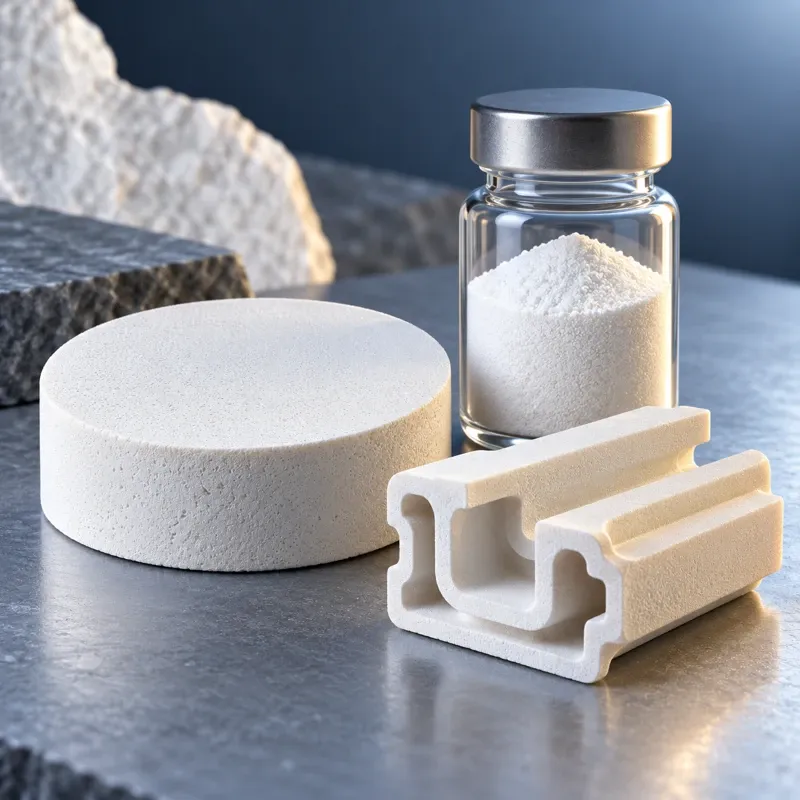
Fused Silica Powder for Injection-Molded Ceramic Cores
Amorphous fused silica powder candidate for injection-molded ceramic core trials. Match phase, PSD and lot chemistry to molding, firing, heat exposure and core removal.
Material application brief ·
Keep core strength and removability in balance
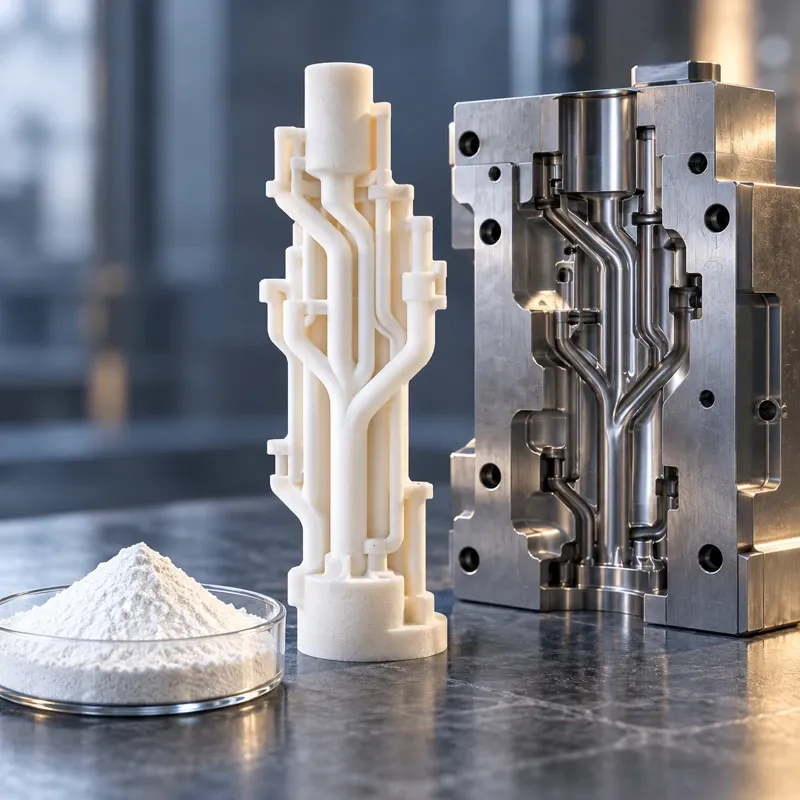
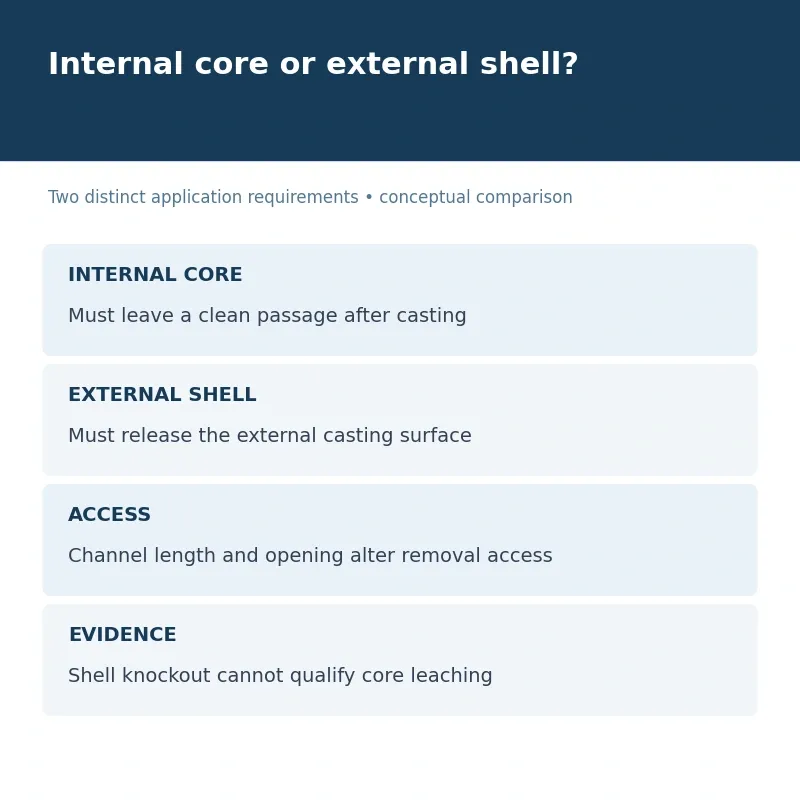
Fused silica powder for injection-molded sacrificial ceramic-core development. A core forms an internal passage in a casting and must retain enough shape and strength through handling and heat exposure, then be removable under the foundry's qualified process. This application is distinct from building an exterior investment-casting shell. Select a fused-silica powder only after matching its amorphous phase, particle-size distribution and impurities to the core body, binder, firing cycle and removal route.
The core buyer's balancing problem
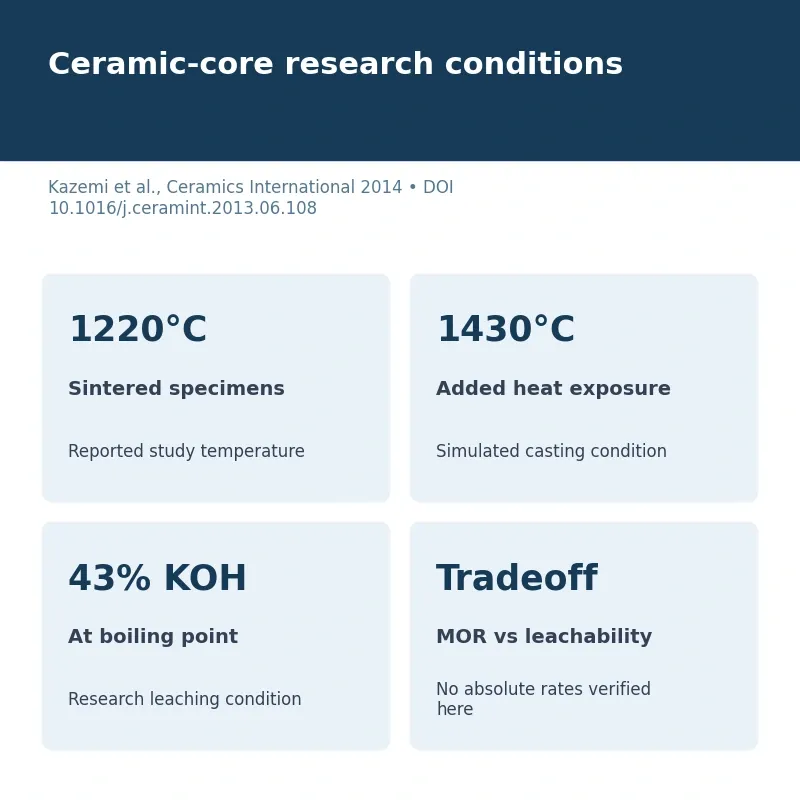
Fine powder supports packing and molded detail, but the complete body also contains coarser fractions, binder and sometimes other minerals. Green strength, fired modulus of rupture (MOR), thermal distortion and leachability must be evaluated together. Research by Kazemi and colleagues on injection-molded silica-based cores investigated zircon content as a formulation variable. Their samples sintered at 1220 °C were subsequently heated to 1430 °C to simulate casting exposure; chemical resistance was evaluated in boiling 43% KOH, with XRD and SEM used to assess phase and microstructure. In those particular bodies, more zircon increased MOR while reducing leachability. The stated bath is a research condition, not a recommended handling instruction or proof that a Changtong powder will perform identically. Research record and DOI.
Properties to match to your core formulation
| Powder or body variable | Why it matters | Requested evidence |
|---|---|---|
| Amorphous phase and residual crystalline phases | Devitrification during firing and casting exposure can change dimensional and removal behavior. | Phase identity/XRD method for the offered lot; separate fired-body XRD after the customer's cycle. |
| PSD and coarse/fine blend | Packing, mold filling and feature definition depend on the complete feedstock, not one mesh number. | D10/D50/D90 in μm and measurement method for each powder fraction. |
| Lot chemistry and moisture | Impurity and water limits should be agreed against binder and casting-alloy requirements. | Current TDS, COA and SDS with batch identifiers and agreed acceptance limits. |
| Green and fired body behavior | Handling strength, shrinkage, MOR and removal belong to the customer's compound and geometry. | Customer coupons and molded cores tested at specified firing and heat-exposure conditions. |
Existing catalog reference: Changtong's general 325 mesh fused-silica powder page lists reference chemistry SiO₂ >99.90% and Fe₂O₃ <50 ppm, with a 325 mesh/approximately 45 μm screen reference. Those are not injection-core grade limits or a COA for this page. Select a candidate and confirm current lot chemistry, phase and full PSD before specifying a core feedstock.
Applications: an internal passage, not a shell
| Use or neighboring product | Decision boundary |
|---|---|
| Injection-molded internal cores | Complex passage geometry, molded green strength, fired stability and post-cast removal drive grade selection. |
| External ceramic shells | Layer building, slurry wetting and shell permeability call for a different qualification path; see low-dust fused silica for shells. |
| Binder-based printed ceramic shapes | Printer flow and debinding are separate from injection-molding behavior; see fused quartz flour for ceramic AM trials. |
Evidence needed before a production decision
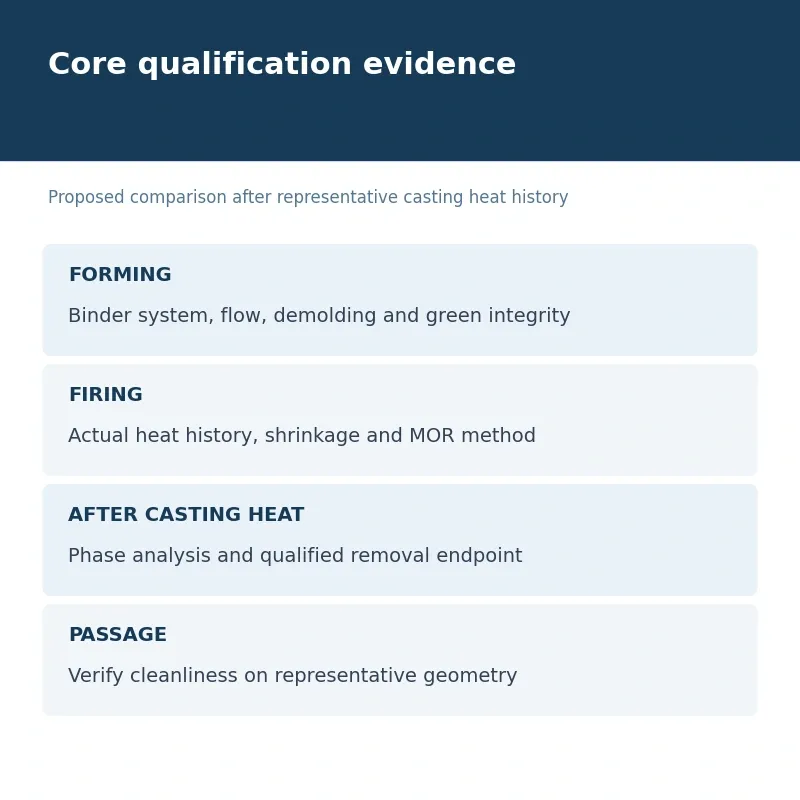
Specify core geometry and minimum wall thickness, molding binder, powder blend, firing atmosphere and schedule, peak casting exposure, alloy and allowable distortion. Run identical green-strength and fired-MOR tests on candidate bodies, then record dimensional change, phase evolution and removability after representative heat exposure. Avoid selecting on strength alone: a strong core that cannot be removed cleanly is unsuitable for an enclosed passage. Define leach conditions through the customer's approved process and safety controls rather than copying a research bath into production.
Frequently asked questions
Does fused silica remain amorphous after the complete cycle?
It may not. Phase evolution depends on impurities and thermal history; compare lot phase data with XRD on fired and heat-exposed cores.
Can the shell powder be used directly for cores?
It is an application candidate only. Internal-core feedstock also needs compatible molding rheology, strength, geometry control and a validated removal route.
What belongs in the RFQ?
Provide target PSD in μm, phase/chemistry limits, current core recipe, binder and molding process, firing cycle, alloy exposure, feature size, required removal test and lot-document format.
Share your core formulation and thermal/removal envelope so Changtong can propose a lot-documented powder candidate.
Request a sample and quotationTechnical source and image context
Kazemi, A.; Faghihi-Sani, M. A.; Nayyeri, M. J.; Mohammadi, M.; Hajfathalian, M. Effect of zircon content on chemical and mechanical behavior of silica-based ceramic cores. Ceramics International 40(1 Part A), 1093–1098 (January 2014). Source record. Peer-reviewed research; institutional publication record and abstract reviewed. Absolute MOR, leaching rates and zircon fractions were not verified. Source checked 15 October 2026. This is background evidence, not a newly published October 2026 study.
Main and detail images are conceptual AI-generated application illustrations, not photographs of Changtong production or tested customer parts. Body figures are original summaries of the stated research and proposed evaluation comparisons; they are not Changtong measurements.