
Hydrophobic Silica Powder for EV Battery Encapsulation
Surface-treated natural quartz filler for EV module encapsulation resin trials. Confirm moisture, PSD and resin compatibility before selecting a grade.
Product Overview
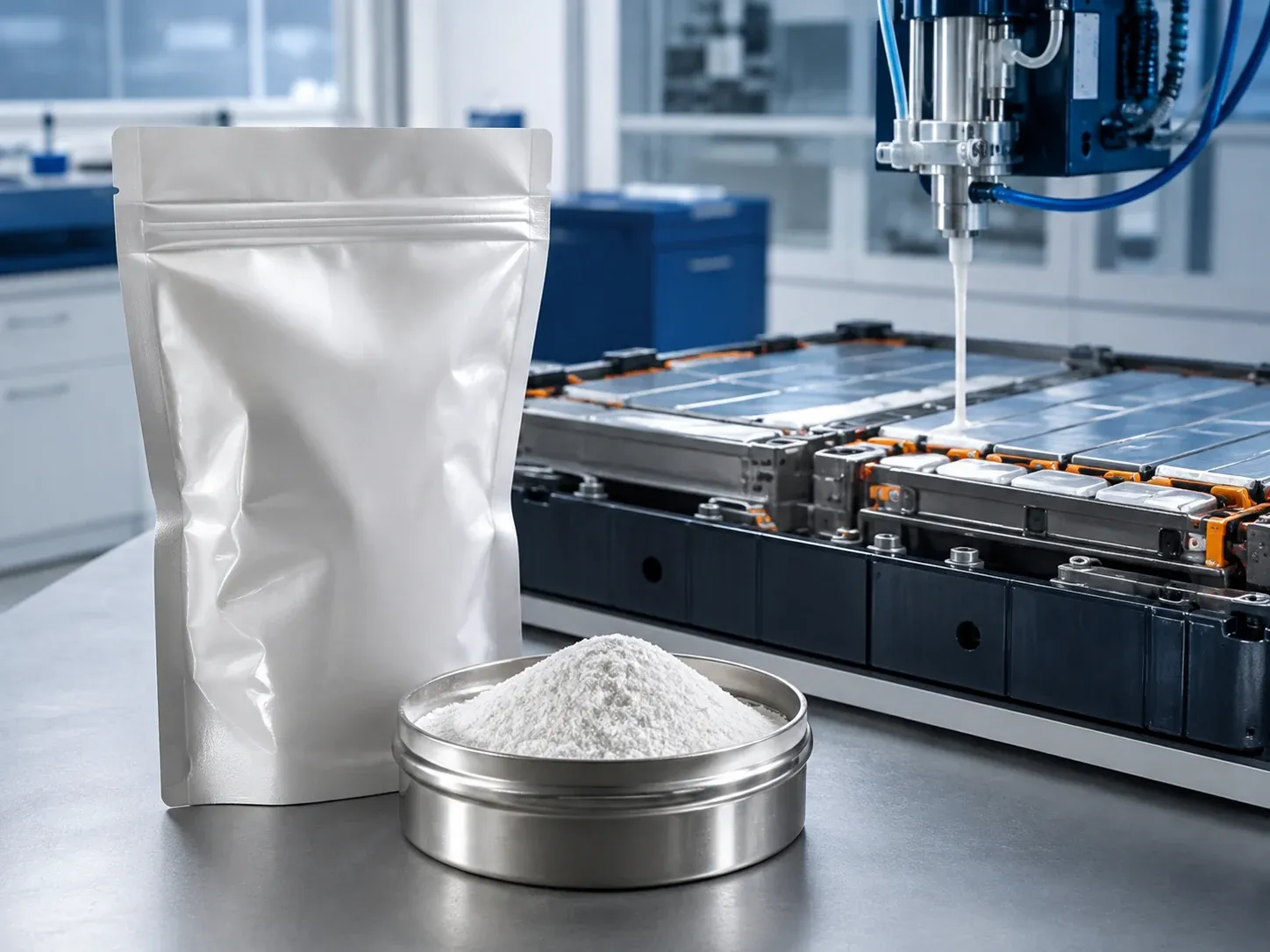
This natural-quartz-derived crystalline silica is surface treated for hydrophobic behavior and supplied for formulation trials in EV battery module encapsulation, sealing and insulation resins. It is a mineral filler—not an electrode active material, electrolyte additive or separator coating. Grade selection must be verified in the customer’s resin, mixing, degassing and curing process.
Why Hydrophobic Surface Treatment Matters
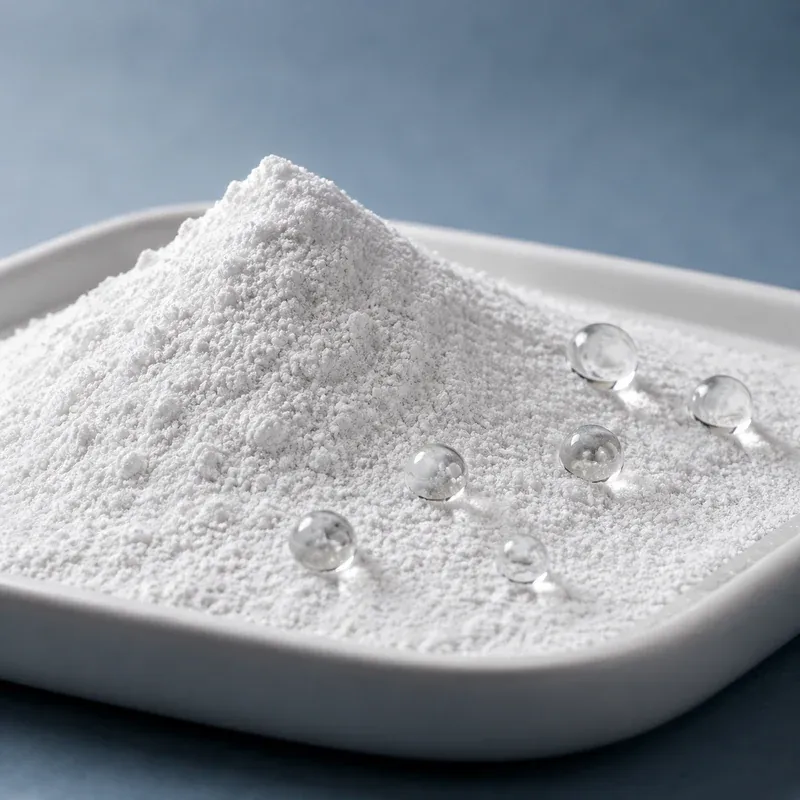
Untreated silica surfaces can interact with moisture and with one another. In a filled resin, those interactions may contribute to agglomeration or viscosity build. Hydrophobic treatment changes the filler–resin interface, but its practical value depends on resin polarity, curing chemistry, filler loading, mixing energy and the order in which ingredients are added.
Moisture Evaluation
Review powder moisture and surface condition against the customer’s storage and processing controls.
Dispersion Study
Compare wet-out, agglomerate breakup and air release under the available mixing and degassing process.
Viscosity Control
Evaluate particle size and treatment together at the intended filler loading; no universal viscosity result is implied.
Resin Compatibility
Confirm compatibility in the actual epoxy, silicone or other encapsulation chemistry before production approval.

Particle Size and Mixing Considerations
A finer fraction may support packing into small gaps, while its higher surface area can increase resin or dispersant demand. A coarser fraction may reduce surface-area-driven viscosity, but gap filling, sedimentation and dispensing behavior still need to be assessed. Selection should therefore start from the module geometry and process window—not from mesh size alone.
Suggested Evaluation Plan
- Confirm powder moisture and the agreed test method before compounding.
- Compare at least two particle-size options at the same resin ratio.
- Record initial viscosity, working time, mixing torque or dispense pressure, and visible air release.
- Test cured hardness, adhesion, dimensional behavior and electrical insulation requirements in the customer’s resin.
- Complete the customer’s thermal cycling, humidity, storage and safety validation before production approval.

Quality Control and Documentation
The final purchase specification should be agreed against defined sampling and test methods. The following items are useful starting points for technical review.
| Review item | Why it matters | Acceptance basis |
|---|---|---|
| Particle-size distribution | Influences packing, flow and dispensing | Confirm against agreed method |
| Moisture | Relevant to storage and moisture-sensitive systems | Confirm against agreed method |
| Surface-treatment status | Supports lot-to-lot interface review | Confirm agreed identification criteria |
| SiO₂ and impurity limits | Defines the approved mineral composition window | Confirm grade-specific limits |
| Lot traceability | Connects delivered material to inspection records | Confirm document and packaging requirements |

Application Boundary
This product is intended for evaluation as a mineral filler in resin-based module encapsulation, potting, sealing and insulation formulations. It must not be represented as a lithium-ion electrode material, electrolyte additive or ceramic separator coating. No battery-level safety, thermal or service-life claim can be made from filler selection alone.
For a controlled evaluation plan, use our natural-quartz-derived hydrophobic silica screening guide. For adjacent polymer formulation work, compare the surface-treated silica grade for polymer masterbatch trials.
Information Needed for Grade Selection
Please provide the resin and hardener names, target filler loading, particle-size or gap requirement, mixing and curing conditions, moisture limit, electrical test requirements, thermal and humidity profile, and packaging preference. These details allow Changtong to review the application boundary and confirm the available grade data before sampling.
Frequently Asked Questions
Does this product increase battery energy density?
No. It is a mineral filler for resin formulation and is not an active battery material. Energy-density claims cannot be inferred from filler selection.
Does hydrophobic treatment guarantee low moisture in a finished module?
No. Powder moisture, resin chemistry, mixing, curing, sealing design and storage all affect the finished compound. The complete formulation must be tested.
Can one grade be used in every potting resin?
No. Compatibility depends on resin polarity, curing chemistry, loading and process conditions. Sampling should be based on the customer’s formulation.
Request an EV Battery Module Encapsulation Grade
Share your resin system, particle-size target and validation plan. We will review available grade data and technical documents before sampling.
Request a Quote