Cristobalite in Ceramic Shells: Balancing Pouring Strength and Knockout
Evaluate cristobalite in investment casting shells with phase checks, pouring-strength evidence and controlled knockout trials before selecting a grade.
Industrial Application Guides · Technical review · First published · Updated
Ceramic shells must survive pouring and still allow practical removal after cooling. This guide separates powder identity, shell performance and knockout evidence when evaluating cristobalite-containing formulations.
A strong shell is only part of the requirement
A shell that survives pouring but takes too long to remove leaves a different problem for the foundry. A shell that breaks away easily but cannot withstand the casting operation is not an improvement either. The material decision needs two acceptance points: performance through the pouring stage and removal behavior after cooling.
When cristobalite is being considered, start with the current failure. Is the shell difficult to knock out, or is the casting already showing damage associated with insufficient shell integrity? Keep these problems separate in the trial record. “Lower shell strength” is not a complete purchasing target.
What the research supports
Bertão and colleagues examined quartz and cristobalite additions in ceramic shell materials using phase characterization, dilatometry and mechanical testing. Their 2026 paper identifies cristobalite as an important contributor to embrittlement and highlights a 0–10% addition interval for further optimization. Higher additions did not produce proportionally greater strength reduction. [1]
The accessible abstract does not establish a ready-to-use addition rate for another shell system. Its percentage basis and full firing conditions must be checked before reproducing the experiment. Treat it as evidence for a controlled formulation study, not as a recommendation to add 10% cristobalite.
Separate the powder record from the shell result
A powder COA describes the supplied material. It does not demonstrate how a complete shell will behave during casting. Ask for phase identity, particle-size information and the relevant lot chemistry, then connect those records to the shell-making conditions.
For a first comparison, use a worksheet that keeps the existing shell system visible.
| Trial question | Record to keep | Proposed decision |
|---|---|---|
| Is the candidate material correctly identified? | Grade, lot, XRD identification and available quantitative phase data | Resolve uncertain phase identity before formulation trials |
| Has shell preparation changed? | Binder, layer sequence, drying conditions, shell thickness and material substitutions | Avoid attributing a preparation change to cristobalite |
| Does the shell remain fit for pouring? | Relevant strength evidence and observed casting defects under the qualified process | Reject easier removal if pouring integrity becomes unacceptable |
| Is removal genuinely improved? | Cooling history, knockout method, time per comparable casting and residual shell | Compare like geometry and the same removal setup |
| Can the result be repeated? | Repeated batches and the same inspection procedure | Investigate variation before approving routine supply |
This is a proposed trial worksheet, not the test protocol from the cited paper.
Check more than a single cold-strength result
Agree which performance measures matter at each process stage. An ambient strength measurement cannot, on its own, establish performance during pouring. Likewise, an easier laboratory break does not establish a faster production knockout cycle.
Record the shell preparation and firing schedule before interpreting the result. Where the trial changes several ingredients, describe it as a formulation comparison. Do not present the outcome as the effect of cristobalite alone.
Use a qualified current formulation as the reference. Choose candidate additions through the foundry's formulation review, keep preparation conditions controlled and repeat the useful comparisons. No universal acceptance threshold is proposed here.
Foundational experiment: why thermal state matters
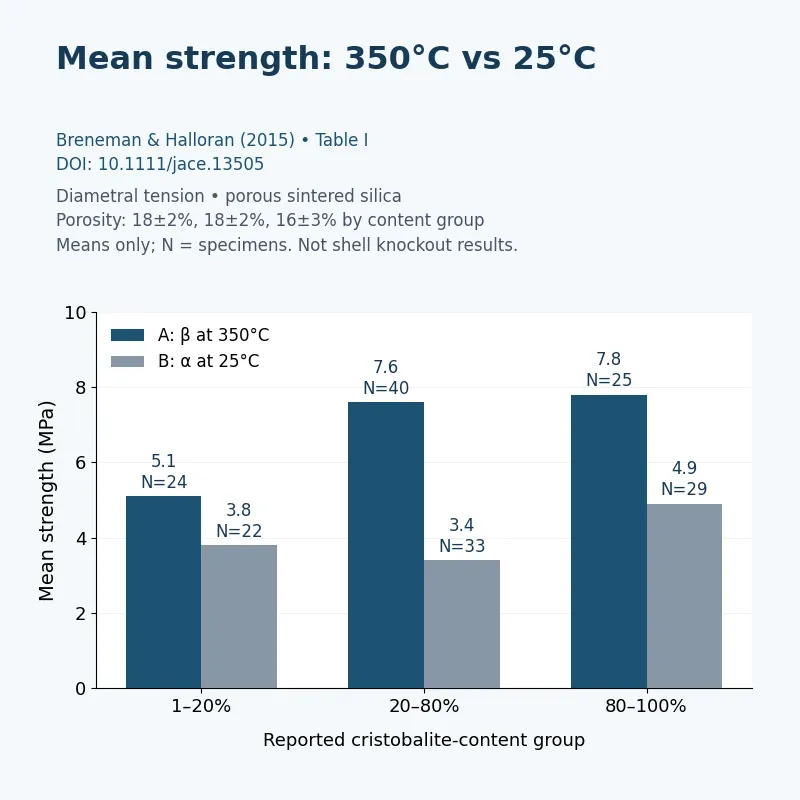
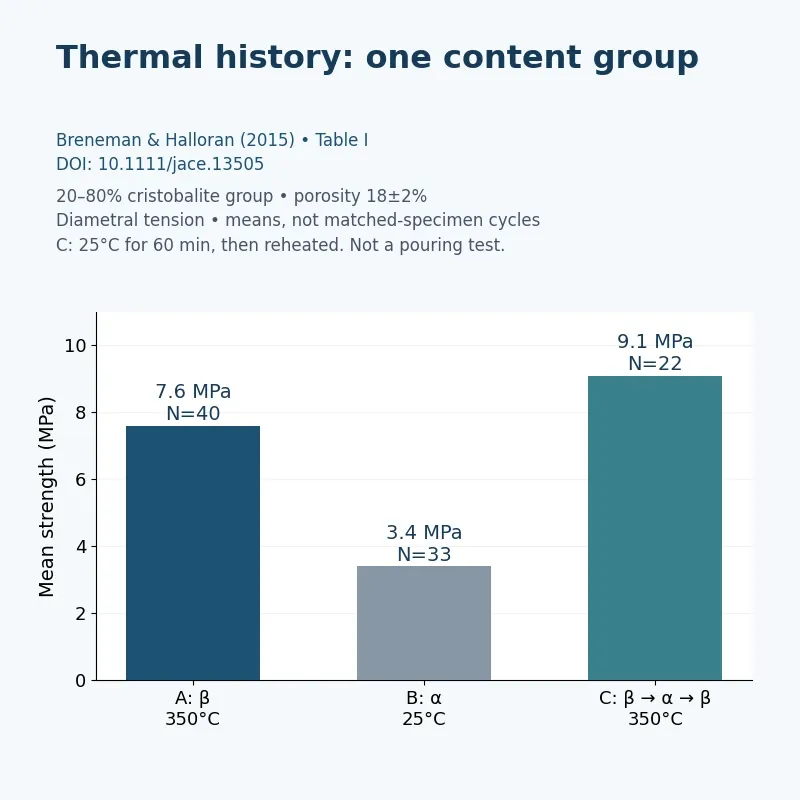
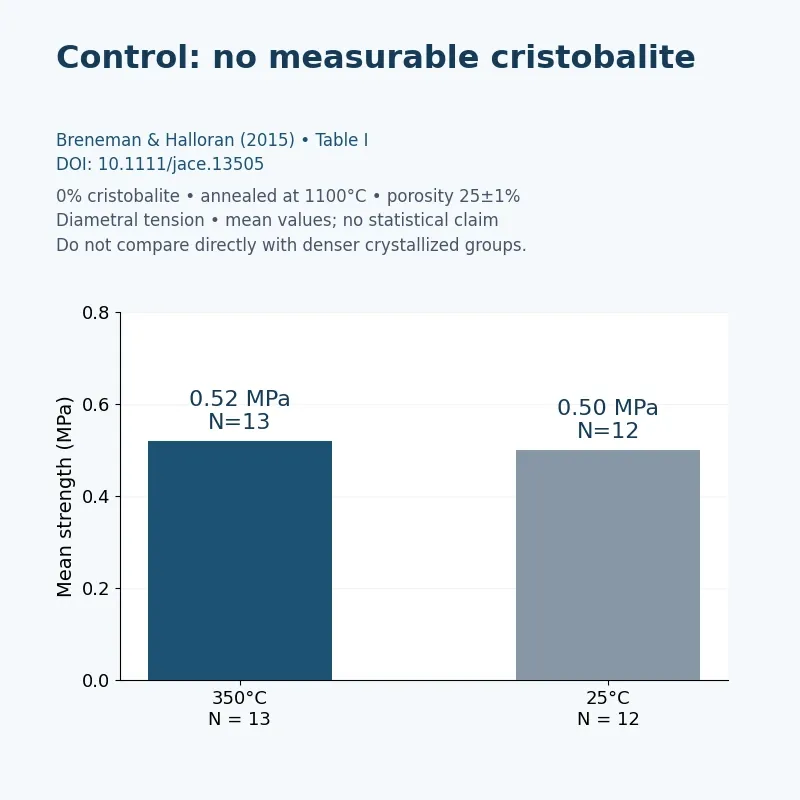
Breneman and Halloran tested porous sintered silica by diametral loading at 0.015 mm/s. The following original plots use their reported means and specimen counts, not reconstructed raw measurements. [2] This 2015 experiment supports a thermal-history check; it does not measure shell knockout time. Its 350°C tests do not qualify a shell at pouring temperature, and crystallized phase fractions are not powder addition rates.
Compare the tested phase and temperature
Retain the cooling and reheating history
Use the amorphous control with its porosity attached
Build a useful supplier enquiry
For the powder-identity and thermal-response checks, review the cristobalite XRD incoming-inspection guide and the guide to reading cristobalite heating, cooling and CTE curves. Keep powder evidence separate from finished-shell qualification.
When discussing cristobalite material options, state the intended shell layer, binder system, firing conditions and current removal problem. Include the powder information required for the trial and the finished-shell checks that cannot be compromised.
For a defined mold-wash or shell-process screening project, review controlled-phase cristobalite for ceramic mold-wash trials. This is a candidate for process-specific evaluation, not a universal shell flour or a qualified substitute. Confirm current phase evidence, particle-size data, chemistry and compatibility with the actual binder, drying and firing schedule before selecting a sample.
Jewelry investment powders, ceramic shells and leachable ceramic cores are different qualification contexts. A grade used successfully in one context should not be treated as approved in another without evidence.
Evidence boundary: This guide discusses a published shell-material study and proposes a purchasing trial record. It does not report a Changtong casting trial or promise a reduction in knockout time.
FAQ
Does the study mean more cristobalite always makes knockout easier?
No. The abstract identifies a limited interval worth optimizing and reports that larger additions did not give a proportional strength reduction. A production decision still requires shell-integrity and removal checks. [1]
Can we replace the current filler directly?
Treat replacement as a formulation change. Review the powder identity, preparation conditions and acceptance criteria before making a production substitution.
Which data should be included in an RFQ?
Provide the application, current shell system, candidate grade requirements, relevant firing and cooling conditions, quantity and delivery destination. Identify whether the priority is shell integrity, removal time or both.
Discuss a shell-material trial
Send the application and trial requirements. Confirm the available grade documentation before selecting a sample; approve performance in the complete shell and casting process.
Reference
[1] Bertão, I., Oliveira, F., Puga, H. and Fragoso, B. (2026). Influence of Quartz and Cristobalite on the Mechanical Behaviour of Ceramic Shell Materials for Investment Casting. International Journal of Metalcasting. Published 25 January 2026. DOI: 10.1007/s40962-026-01877-8. This article relies on the publisher's accessible abstract, not the subscription full text.
[2] Breneman, R. C. and Halloran, J. W. (2015). Effect of Cristobalite on the Strength of Sintered Fused Silica Above and Below the Cristobalite Transformation. Journal of the American Ceramic Society, 98(5), 1611–1617. First published 19 February 2015. DOI: 10.1111/jace.13505. Data: Table I; conditions: Section II(3), primary text indexed from the University of Michigan repository, checked 9 October 2026. Direct PDF retrieval was unavailable during preparation. Plots are original redraws of tabulated means, without copied publisher artwork.