Evaluating Low-Crystalline-Silica Slabs Requires More Than a Chemistry COA
Separate raw filler phase content, finished-slab composition and task-specific dust evidence. Includes a mass-balance example and a quantitative XRD checklist.
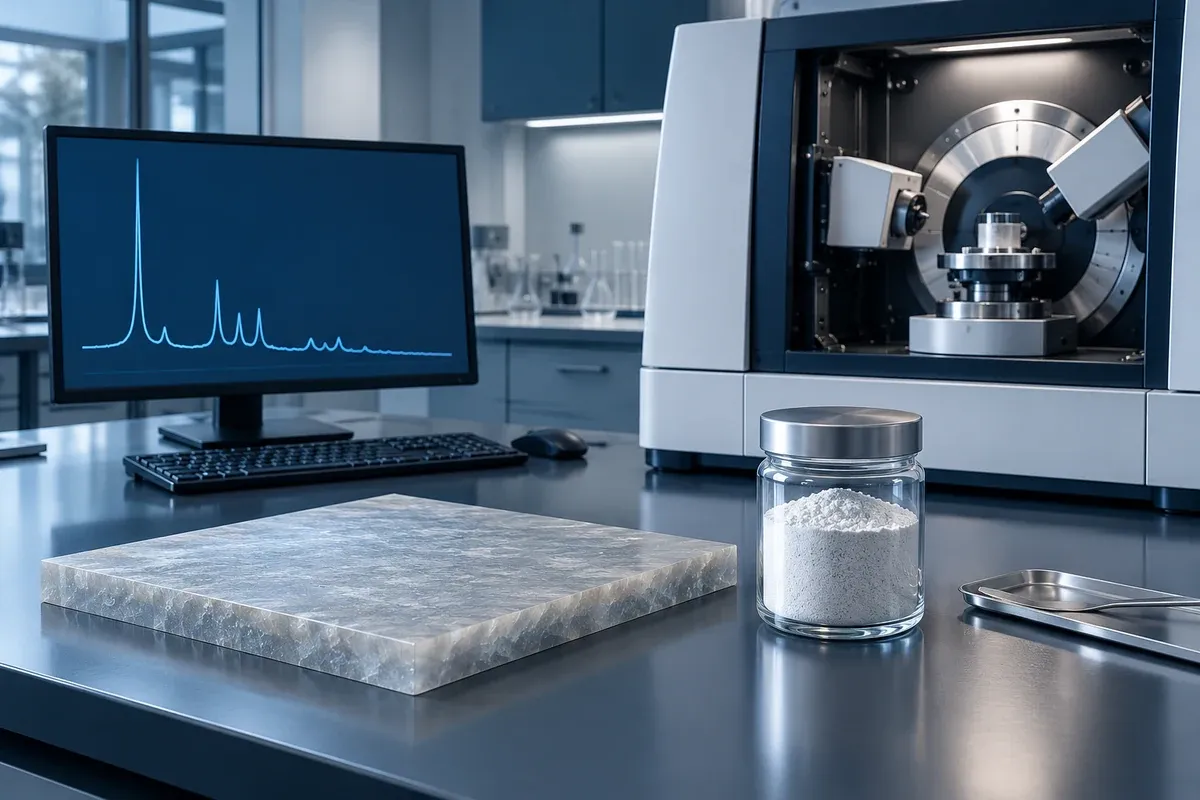
A purchaser receives a certificate of analysis showing total SiO2 and asks a simple question: what is the crystalline-silica percentage? The COA may not contain the answer. Total oxide chemistry and mineral phase are different measurements. A material can report silicon dioxide in its chemistry without that number telling the buyer how much quartz, cristobalite or tridymite is present.
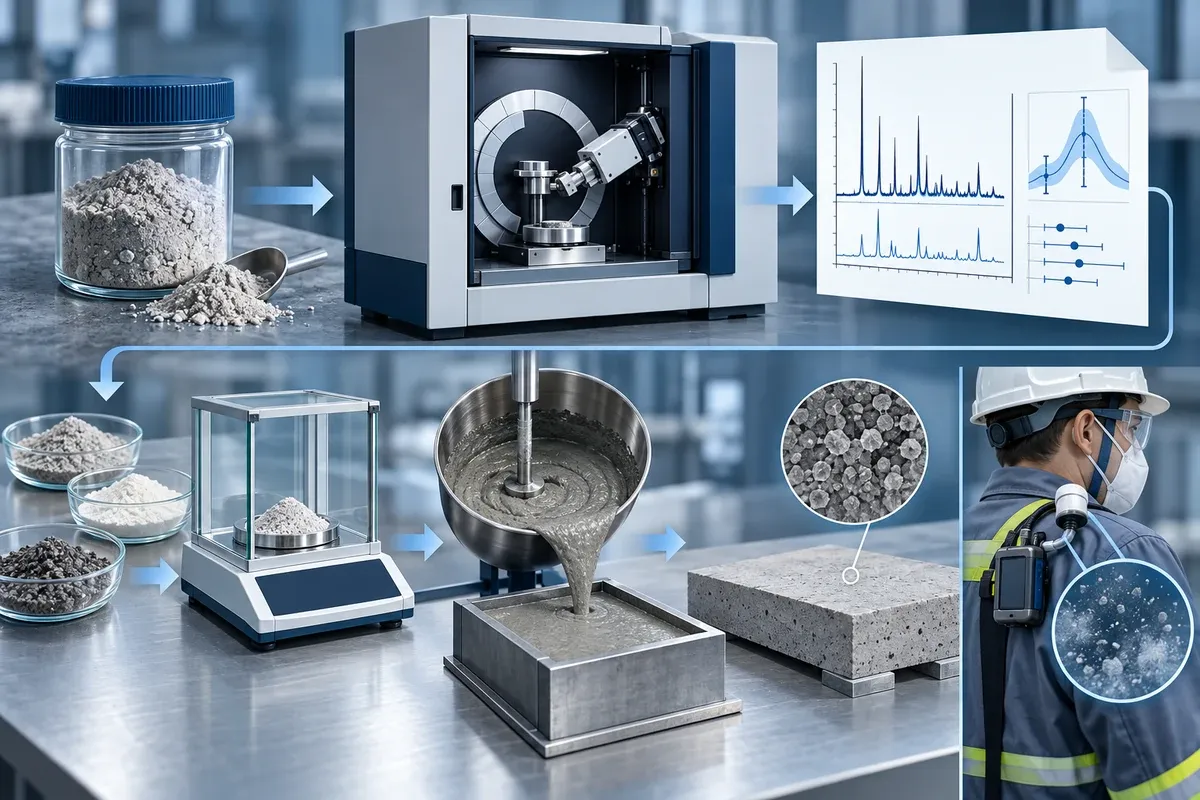
For a resin-bound slab, the evidence question has three separate levels: the raw filler, the finished composite, and dust generated during a defined work activity. Each requires its own sample, method and interpretation.
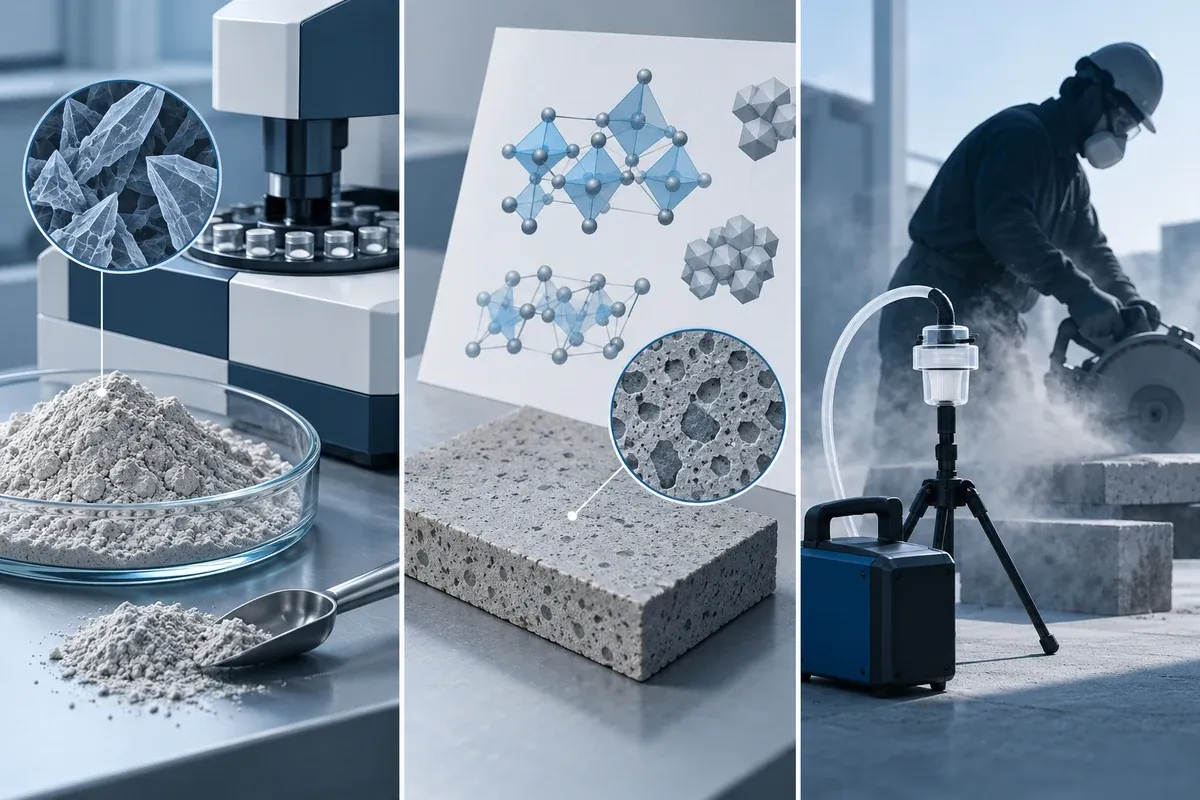
Three questions, three evidence sets
A chemistry COA remains useful for identity and specified oxide limits. It should sit alongside—not replace—phase-specific evidence when the purchasing question concerns crystalline silica. In the customer-provided glass R&D report reviewed for this draft, oxide composition includes 70.89% SiO2; the report does not supply an independent quantitative phase result. A separate customer-provided sand evaluation reports color, grading and contamination checks, but it also is not a quantitative phase analysis or an exposure study.
A separate 2014 qualitative XRD report classified two particular fused-silica powder samples, named 325F and 200F mesh in the source record, as amorphous. That historical finding is qualitative only: it reports no crystalline-silica wt%, detection limit, LOQ or uncertainty. It applies to those powder samples at that time, not to a current lot, glass, sand or a finished slab. It is not proof of zero, below 1%, or any current product claim. Keep this observation separate from both the 2024 glass chemistry record and the sand QC evaluation.
Use a transparent mass balance for the formulation estimate
With the raw-material phase fraction measured, estimate the slab fraction on a mass basis:
Estimated crystalline-silica fraction in slab = Σ (ingredient mass fraction in slab × crystalline-silica fraction of that ingredient)
Consider a deliberately hypothetical batch containing 20 kg of mineral filler measured at 90% crystalline silica and 10 kg of resin assumed to contribute none. The estimated slab fraction is (20/30 × 0.90) + (10/30 × 0) = 0.60, or 60% by mass. This example is only arithmetic: it is not a result for any Changtong product, customer formulation or supplied sample. A real calculation must include every ingredient that may contain relevant phases, the actual batch masses and the agreed basis. Verify the estimate on a representative slab specimen.
Do not convert a slab percentage into an exposure conclusion. Cutting, grinding, polishing, material moisture, tool choice, enclosure, extraction, work practices and respiratory protection all influence the dust a worker may encounter. Exposure assessment belongs to the task and workplace, not to a filler COA alone.
What makes an XRD result decision-ready?
Before accepting a phase result, ask the laboratory and supplier to make the chain auditable:
- Identity and sampling: lot or batch ID, collection location, date, number of increments, compositing method, sample preparation and chain of custody.
- Method and phases: X-ray diffraction method, preparation details, calibration or reference approach, and which crystalline phases were quantified. Ask how amorphous content is handled if it matters to the stated result.
- Limits and uncertainty: reporting units and basis, limit of quantification (LOQ), measurement uncertainty, and whether a result below the LOQ is reported as “not quantified” rather than “zero.”
- Representativeness: confirmation that the tested portion represents the material and lot being purchased, plus a retest plan for process, source or formulation changes.
- Separate workplace assessment: where dust exposure is the concern, define the activity and controls and obtain task-based monitoring rather than inferring an airborne value from bulk-material chemistry.
For a glass-based trial, buyers can review fused glass powder. A quartz-based program may begin with fused quartz powder or fused quartz sand, subject to lot-specific phase documentation and the buyer’s own qualification criteria. The product-page names describe a material family; confirm the exact grade, lot evidence, stock and application fit with the supplier.
Keep regulatory review jurisdiction-specific
Material evidence does not determine market access on its own. Requirements depend on product design, intended use, location and current rules. For example, Australia has specific engineered-stone prohibitions and import controls; consult Safe Work Australia’s engineered-stone guidance and the Australian Border Force import guidance for the applicable scope. This example should not be read as a global rule or legal advice. Buyers should check the competent authority in each destination market.
Frequently asked questions
Can total SiO2 on a COA be used as the crystalline-silica value?
No. It is a chemistry result, not a phase split. Ask for quantitative phase analysis using a method suitable for the sample and decision.
Does a result below the LOQ mean zero?
No. It means the method did not quantify a value above its stated reporting capability under the test conditions. Retain the LOQ and uncertainty with the report and phrase conclusions accordingly.
What should I send for a documentation review?
Provide the lot COA, phase report, intended recipe basis, target application, destination market and any workplace task context. Contact Changtong to discuss material documentation and sample qualification.
Evidence boundary: The cited internal records are customer-provided historical R&D evaluations, not independent certifications or current specifications. No phase fraction, finished-slab crystalline-silica percentage, exposure level, “less than 1%” status or zero-content claim is established here. Confirm current evidence and applicable requirements before making a product or compliance statement.
Related products
Related technical guides
Technical and regulatory references
Request a quote for your slab filler trial
Share your target grading, resin system, intended use and evaluation requirements to prepare a focused request for quote.
Request a quote