Reading Strength, Hardness and Abrasion Together in Glass-Filled Slab Trials
Read flexural strength, impact, absorption, density, Mohs hardness and deep abrasion as separate results when qualifying a glass-filled slab trial.
ENGINEERED STONE · TEST INTERPRETATION
A slab can show strong bending results and sit within one abrasion limit while a hardness reference invites further qualification. Those measures describe different responses to different test actions. Reading them separately helps a buyer translate a development result into a clear specification.
One anonymized research-and-development report makes the distinction concrete. Its finished fused-glass slab recorded 94.6 MPa flexural strength under the report's ASTM C880 label, 9.4 J impact resistance under EN 14617-9:2005, and 0.046% water absorption under ASTM C97. Apparent density was 2.21 g/cm³, also labelled ASTM C97. The same report lists Mohs hardness as 5–6 against a 6–7 reference, while deep abrasion measured 234 mm³ against a limit below 240 mm³. Together, the values form a profile, not a single verdict.
Read the scorecard as separate questions
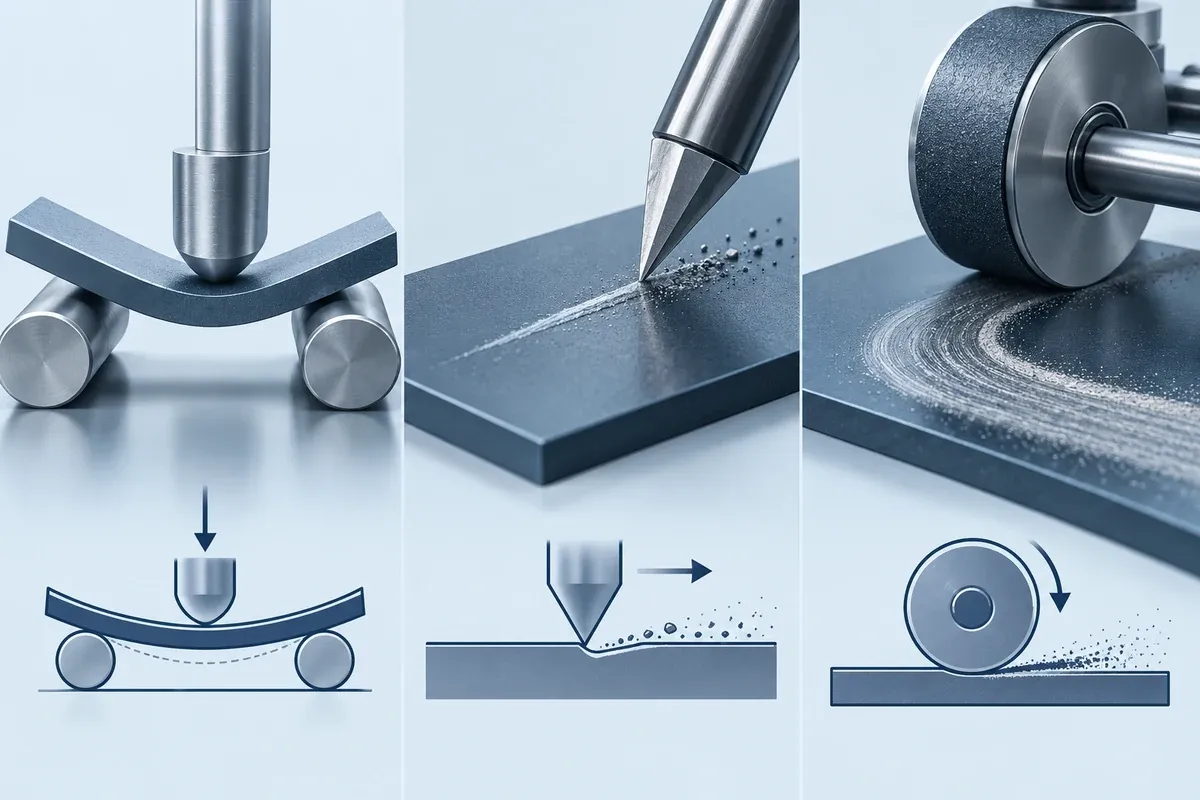
Flexural strength asks how the specimen performed under the stated bending test. Impact resistance records a different loading event. Water absorption and apparent density characterize other properties again. None of those numbers can be used as a proxy for scratch resistance. Mohs is a comparative scratch-hardness scale; deep abrasion records material loss under a specified abrasion procedure. A result near one threshold cannot substitute for evidence on another property.
The near-limit abrasion result deserves a margin conversation
At 234 mm³ versus a report limit of less than 240 mm³, the arithmetic gap is 6 mm³. Relative to the 240 mm³ ceiling, that is 2.5%. This is a simple comparison of the displayed values, not a measurement-uncertainty estimate, process capability statement, or prediction of production variation. The report labels the abrasion method ASTM C1243:2009; retaining that label identifies what the report says, without claiming that it is the latest method or suitable for every product and application.
For a buyer, a small numerical gap is a reason to ask how repeatable the result is, not a verdict about performance. Request replicate results, specimen conditioning, the laboratory's reporting precision, and confirmation that the test setup matches the intended acceptance protocol. If the end use has a tighter wear requirement, agree on the threshold and sampling plan before a production trial. Do not convert 234 mm³ into a Mohs value or infer scratch performance from abrasion alone.
Hardness remains its own qualification item
The 5–6 Mohs result intersects the lower end of the 6–7 reference only at 6, and the reported interval also includes 5. It therefore does not demonstrate the full stated reference range. That nuance matters even if flexural strength, impact, absorption, density, and abrasion compare favorably with their listed limits. A material can perform well on several dimensions while needing more work—or a different acceptance discussion—on another.
Ask whether hardness was measured on a representative finished surface, whether the intended finish and exposure are relevant, and whether the customer's scratch or wear protocol is more appropriate than a general reference interval. The supplier can help plan another trial, but only an agreed test and sampling plan can close the qualification gap. For a different particle role, compare the intended feedstock carefully: fused glass powder for engineered-stone slabs and fused glass sand for engineered-stone slabs should not be treated as interchangeable simply because both are glass-based.

Questions to settle before approval
Does 94.6 MPa flexural strength mean the surface is scratch resistant?
No. Flexural strength measures bending response under the stated test. It does not determine Mohs hardness or scratch behavior.
Does 234 mm³ prove the slab meets every abrasion requirement?
Only relative to the less-than-240 mm³ limit shown in this report, under its stated method label. A buyer should confirm the applicable method, acceptance limit, repeatability, and intended-use protocol.
Can this report support a production guarantee?
No. It documents one R&D result. Production qualification requires agreed sampling, repeat testing, process controls, and customer acceptance criteria.
Planning a slab trial? Send the target property limits, finish, intended application, test method, and sampling plan through our contact page so the next sample can answer a defined qualification question.
Related products
Related technical guides
Request a quote for your slab filler trial
Share your target grading, resin system, intended use and evaluation requirements to prepare a focused request for quote.
Request a quote