Advanced Packaging Warpage: A Fused Silica Filler Test Plan for Epoxy Molding Compounds
A trial-ready guide to evaluating fused silica for advanced-package epoxy molding compounds, from grade records and PSD to controlled package warpage evidence.
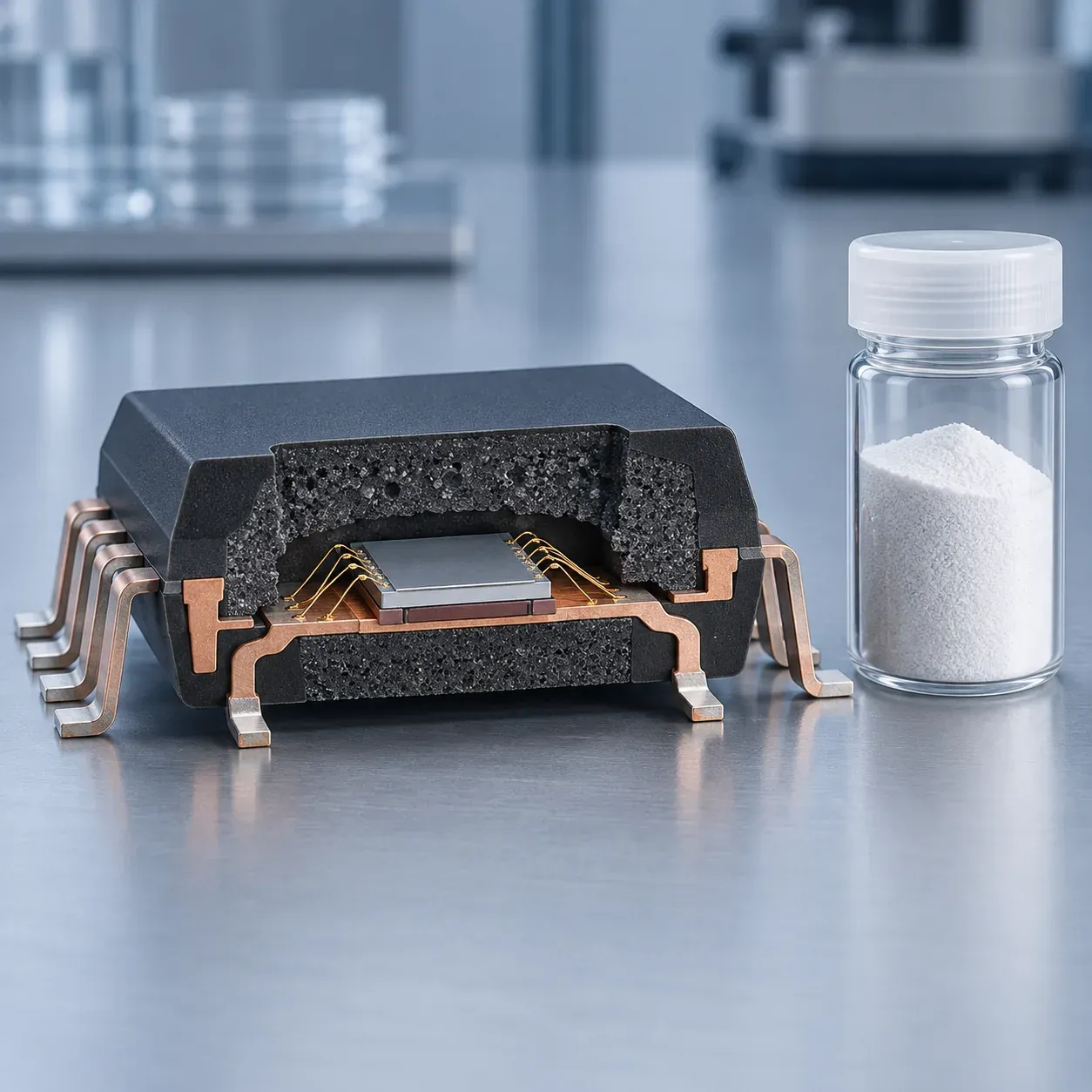
Advanced packaging makes warpage a material-and-process decision, not a single filler number.
Scope: a practical way to screen fused silica powder for epoxy molding compounds used in advanced semiconductor packaging. This guide does not promise a package-level CTE or warpage result. Grade-specific values, the current TDS/COA, cure profile and a customer trial remain the release basis.
Why filler evidence becomes more demanding in advanced packaging
Fine-pitch and heterogeneous packages put more interfaces into a smaller stack. That makes the useful question for a formulator more specific than “what is the silica content?”: which fused silica grade, particle-size distribution and cure condition can be traced to the package response being reviewed?
| Decision variable | Why it belongs in the review | Evidence to keep |
|---|---|---|
| Material identity | Confirms that the selected material is fused silica rather than a different silica phase. | Current TDS/COA and agreed incoming-inspection record. |
| Particle-size distribution | Affects packing, flow and dispersion; a median alone is not a complete comparison. | PSD method, D10/D50/D90 where supplied, and sample lot. |
| Cure and package response | A powder result cannot replace a defined resin, cure profile and package geometry. | Formulation, cure schedule, package build and measurement method. |
Treat phase identity, PSD and cure schedule as a linked system
Start with the grade identity, then hold the resin system and test build constant while changing only the variables under review. This avoids attributing a package outcome to a filler when it may have moved with moisture handling, dispersion energy, loading, cure ramp or substrate build.
A staged warpage trial that creates usable evidence
- Define the decision: identify the package family, thickness stack, target cure and measurement checkpoints.
- Lock the material record: retain the received lot, current COA, PSD method and moisture-handling condition.
- Screen the compound: document dispersion, flow and molding observations before reading package results.
- Measure the package: compare like-for-like builds and retain the raw method settings with the result.

Move from powder screening to package-level evidence
The screening plan should move from powder documentation to compound processing and finally to the defined package. Each level answers a different question; none should be substituted for the next.
| Stage | Question answered | Do not conclude yet |
|---|---|---|
| Incoming powder | Is the submitted grade and lot documented as specified? | Package reliability or production capability. |
| Compound | Does the formulation run under the agreed process window? | Warpage across another substrate or cure schedule. |
| Package build | What is observed on the defined design and method? | A universal grade ranking. |

Thermal cycling is a confirmation step, not a shortcut
Use the customer’s component and cycle method to evaluate the shortlisted formulation. A chamber exposure without the agreed package build or inspection plan can indicate an observation, but it cannot stand in for a qualification decision.

Related Changtong Products
Low-Expansion Fused Silica for Semiconductor Epoxy Molding Compounds is the appropriate starting product page for a grade-specific discussion. Include the package use case, expected particle-size range, formulation constraints and the documents needed for evaluation.
FAQ
Can a powder datasheet predict package warpage?
No. It supports material selection, but the package result requires the actual resin, cure, geometry and measurement method.
Which documents should accompany a trial lot?
Request the current TDS/COA, grade identity, PSD method and any agreed handling information. Confirm the applicable lot before release.
Should one result be applied to every package?
No. A result is specific to its package build and test method. Treat transfer to another design as a new engineering review.
Request a Fused Silica EMC Trial Discussion
Send the package type, epoxy system, target PSD, cure profile, trial quantity and documentation requirements. Our team will align the discussion with the current grade record.
Request a QuoteReference material: NIST advanced-packaging warpage research. Industry references support context only; they are not Changtong test data.