Silica Powder Bulk Density and Tap Density: A Formulator's Test Plan
A practical test plan for using bulk density and tap density to compare silica powders without confusing packing behavior with formulation performance.

This technical guide is a screening and trial framework. It does not establish a universal grade limit or guarantee finished-product performance; approval remains tied to the buyer’s method, formulation and applicable requirements.
Start with the decision, not the number
Bulk density and tap density are useful screening measurements when a formulator needs to understand how a silica powder occupies space in a blend. They do not predict finished-product performance by themselves. The value comes from measuring both in a controlled way, pairing the result with particle-size evidence, and then checking whether the powder behaves as expected in the real formulation.
Define the question before choosing the test
Use bulk density when the practical question is how the powder settles after a defined pour. Use tap density when the question is how much the same sample consolidates after controlled mechanical tapping. The two values describe different states; reporting one without the other can hide a large packing change.
Write the decision that the measurement must support. A dry-mix producer may care about silo volume, feeder calibration or bag fill. A resin formulator may care about whether a filler blend can reach its target loading without excessive viscosity. The test should answer that decision, not create a standalone ranking of powders.
Control the sample and apparatus
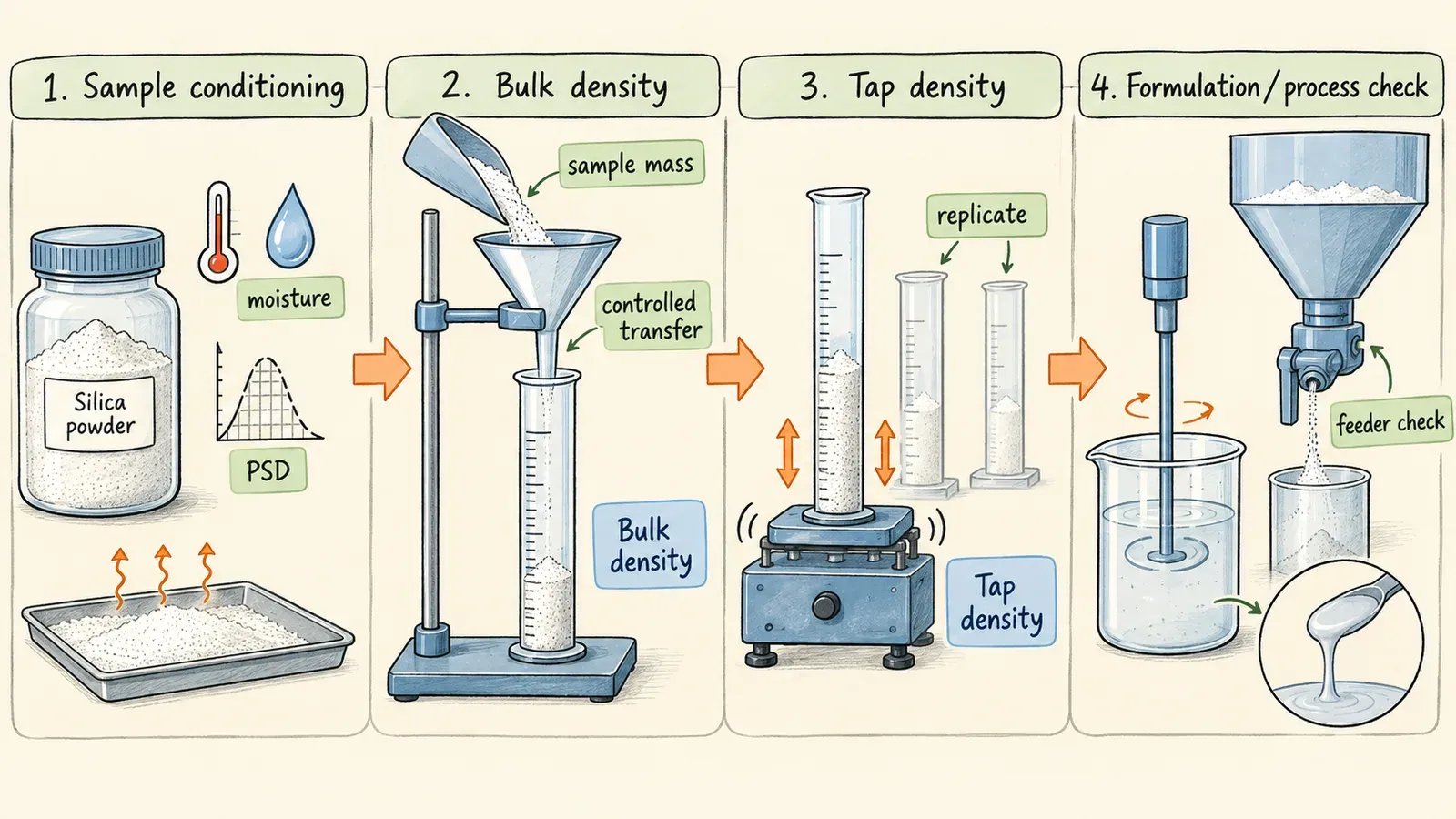
Record sample identity, conditioning history, container volume, balance resolution, funnel geometry, fill height and tapping equipment. Fine silica can retain air or form soft agglomerates, so the way the sample is transferred can change the apparent result. Keep the transfer method identical for every candidate.
Do not compact the powder by hand before the bulk reading. For the tap reading, define the tap count, stroke or instrument setting and the point at which the volume is read. If the method is adapted from an internal procedure or a recognised powder standard, record that basis and any deviations.
Calculate and report the change
Bulk density is commonly expressed as mass divided by the occupied bulk volume. Tap density uses the occupied volume after the specified tapping sequence. Report units, sample mass, replicate results and the calculated change between the two states. A single value without method details is difficult to compare across laboratories.
A large difference between bulk and tap density may indicate that the powder rearranges readily, contains entrained air or has a broad packing response. It does not identify the cause. Compare the result with PSD, moisture, morphology and any deagglomeration step before changing the formulation.
Connect density to the formulation
For a dry blend, monitor hopper discharge, feeder settings, dusting, segregation and the mass delivered per cycle. For a liquid resin or polymer compound, keep the resin, dispersant, mixing energy and filler loading constant while comparing the candidate powder. Record wetting time, torque or viscosity trend, entrained air and final appearance.
Density can also expose a scale-up risk. A powder that looks easy to charge in a beaker may bridge in a larger hopper, while a denser powder may overload a feeder if the recipe is transferred by volume rather than mass. Treat bulk and tap density as process data, not as a substitute for a gravimetric recipe.
Use a small decision matrix
Compare at least the control grade and one candidate using the same sample conditioning and replicates. Keep a separate column for the observed process response so the density result is not mistaken for proof of compatibility.
Decision matrix
| Observation | What it may suggest | Next check |
|---|---|---|
| Low bulk density | Open packing or retained air | Repeat transfer and inspect PSD/moisture |
| High tap consolidation | Large rearrangement under tapping | Check morphology and agglomeration |
| Similar density, different flow | Density alone is not controlling | Run feeder or formulation trial |
| Density changes by lot | Method or lot variability | Review conditioning and COA scope |
Practical checklist
- Define the process decision and reporting units.
- Condition and transfer every sample the same way.
- Run replicates and record apparatus settings.
- Pair density with PSD, moisture and morphology evidence.
- Verify the result in the actual feeder or formulation before approval.
Related technical reading
Use these current pages to connect the test plan to the next purchasing or formulation decision:
These links provide context only. Confirm the current grade, lot documents and customer-side trial conditions before approval.
Discuss a silica material trial
Send the application, material identity, target method, acceptance fields, expected quantity and required documents. Changtong can help structure a sample and evidence review without treating a single laboratory value as a performance guarantee.